The Yamuna cannot become fit for bathing in the absence of a minimum environment flow in the river, the Delhi government has said in a report submitted in the Union Jal Shakti Ministry.
It also said of the 35 sewage treatment plants in Delhi, 22 do not meet the wastewater standards prescribed by the Delhi Pollution Control Committee (DPCC).
Of the 13 Common Effluent Treatment Plants in industrial areas across Delhi, only six comply with the DPCC standards for wastewater.
"Minimum environmental flow for the dilution of the polluted water in the Yamuna in Delhi is required to meet the desired water quality levels in the river for bathing purpose i.e. BOD<3 mg/l and DO>5 mg/l," the report read.
According to the International Union for Conservation of Nature, an environmental flow is the water provided within a river, wetland or coastal zone to maintain ecosystems and their benefits where there are competing water uses and where flows are regulated.
A study conducted by National Institute of Hydrology, Roorkee, has recommended that 23 cubic metre per second (cumec) water be released in the river from the Hathnikund Barrage in Haryana's Yamuna Nagar district in the lean season for sustaining downstream ecosystems.
"The ministry/National Mission for Clean Ganga has observed that the water sharing agreement of 1994 among the riparian states of Uttarakhand, Himachal Pradesh, Uttar Pradesh, Haryana, Rajasthan and Delhi is due for revision only in 2025 unless any of the states so demand, implying that no revision of water sharing will be possible to achieve the E-flow in the Yamuna," the city government's report read.
"In the absence of a minimum environment flow of the Yamuna in Delhi, it is very difficult to achieve bathing quality standards," it said.
The 22 km stretch of Yamuna from Wazirabad to Okhla in Delhi, which is less than two per cent of the river length, accounts for about 80 per cent of the pollution load in the river.
There are 18 major drains, including Shahdara, Najafgarh and Barapulah, which outfall in the river.
Untreated wastewater and poor quality of effluent discharged from CETPs and sewage treatment plants is the major reason behind pollution in the river in Delhi, according to experts.
The DPCC also told the ministry that of the 35 sewage treatment plants in Delhi, 22 do not meet the prescribed wastewater standards with respect to total soluble solid, chemical oxygen demand, biological oxygen demand, dissolved phosphate and ammonical nitrogen.
Ammonical nitrogen and phosphate in the wastewater should be less than 5 mg/l and 2 mg/l, respectively.
According to DPCC norms, TSS should be less than 10 milligram per litre, BOD should be less than 10 mg/l and COD should be below 50 mg/l.
In an inspection conducted in June, 34 of the 35 STPs were found operational. Samples could be collected from 33 STPs.
Of these, 11 were found complying to the standards prescribed by the DPCC.
Inspections could not be conducted in April and May due to the Covid pandemic, the DPCC said.
Delhi generates around 720 million gallons a day of sewage which is treated at these 35 STPs having a cumulative treatment capacity of 597 MGD.
Around 86 per cent of the treatment capacity is being utilised at present, according to government data.
It also said of the 13 CETPs in Delhi, seven do not meet effluent standards.
These CETPS are in industrial areas of Naraina, Lawrence Road, Nangloi, Wazirpur, Mangolpuri, Mayapuri and Jhilmil.
Earlier this month, the DPCC had imposed a fine of over Rs 12 crore on 12 common effluent treatment (CETPs) plants operating across the capital for not meeting prescribed wastewater discharge standards repetitively.
There are 24 industrial areas in the capital of which 17 are connected to 13 CETPS which treat the wastewater from the industrial units before it can be reused or discharged into the Yamuna.

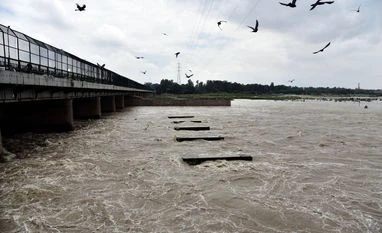 "Yamuna can't become fit for bathing in absence of e-flow: Delhi govt")

