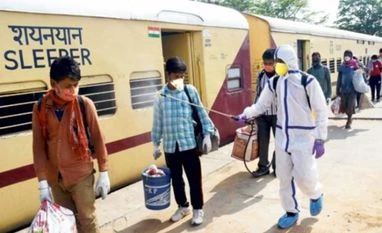
Bihar has received the maximum number of migrant labourers through special trains so far and West Bengal the least, data accessed by the PTI shows, with officials indicating that the latter was "stalling" the movement of its workers stranded in other states.
TMC MP and leader of the party in Rajya Sabha, Derek O'Brien, however, said the West Bengal government was doing "all it takes" to fight the coronavirus pandemic, and accused the Centre of playing politics.
The data shows that most migrant labourers have moved from Gujarat to their home states in about 35 Shramik Special trains so far, followed by Kerala from where 13 such trains have left.
Among the receiving states, Bihar has accepted 13 trains, with 11 more currently on the journey and six in the pipeline, the data shows.
Neighbouring Uttar Pradesh has received 10 such trains and five more are on their way, with 12 in the pipeline, the data shows.
The West Bengal government has, however, given clearance to only two trains -- one each from Rajasthan and Kerala -- and they are on their journeys to the state, the data shows.
A senior official said, "While other states which have their migrant workers in other parts of the country are accepting their labourers, West Bengal is stalling (the process). Two trains -- from Thane to Shalimar and another from Bangalore to Howrah -- which were supposed to run today, did not get clearance from the West Bengal despite both the originating state governments pushing for it."
"Rajasthan has also been slow in accepting migrants with just three trains ferrying its workers back to the state, which are currently on their way," the official said.
Derek O'Brien accused the Centre of playing politics over the issue.
"States, including Bengal, are going all out -- fighting corona. Unfortunately, the Central government is going all out -- fighting and badmouthing non-BJP states using its different ministries.
"States are the implementing authorities. We are all doing all it takes. This is not the time for politics. Or we too can ask: why was a 21-day lockdown announced with four hours notice?" he said.
According to figures from 2011 census, West Bengal ranks fourth among the states from where people migrate for work and employment.
Between 2001 and 2011, nearly 5.8 lakh people migrated from the state for work, which is fewer only than Uttar Pradesh (37.3 lakh), Bihar (22.6 lakh) and Rajasthan (6.6 lakh).
The railway data shows that Jharkhand accepted four trains, while five trains are on their way to the state. Two more Shramik Special trains are in the pipeline.
Odisha received seven trains and five are on their way to the state with one more in the pipeline, the data shows.
The Railways on Tuesday said that since May 1, when Shramik Special trains started operations, it has run 76 of them, carrying more than 70,000 stranded migrant labourers.
Till May 4, the Railways had run 55 trains.
On May 5, it ran 12 trains in the morning and nine in the evening, taking the tally to 76. It said that zonal railways were planning to run 12 more by the end of the day.
One subscription. Two world-class reads.
Already subscribed? Log in
Subscribe to read the full story →
Smart Quarterly
₹900
3 Months
₹300/Month
Smart Essential
₹2,700
1 Year
₹225/Month
Super Saver
₹3,900
2 Years
₹162/Month
Renews automatically, cancel anytime
Here’s what’s included in our digital subscription plans
Exclusive premium stories online
Over 30 premium stories daily, handpicked by our editors


Complimentary Access to The New York Times
News, Games, Cooking, Audio, Wirecutter & The Athletic
Business Standard Epaper
Digital replica of our daily newspaper — with options to read, save, and share


Curated Newsletters
Insights on markets, finance, politics, tech, and more delivered to your inbox
Market Analysis & Investment Insights
In-depth market analysis & insights with access to The Smart Investor


Archives
Repository of articles and publications dating back to 1997
Ad-free Reading
Uninterrupted reading experience with no advertisements


Seamless Access Across All Devices
Access Business Standard across devices — mobile, tablet, or PC, via web or app
)