'Costly' power pacts saddle UP discoms with losses

This could be a major problem for debt-ridden discoms as the new govt has promised 24-hour supply
chart
Shreya Jai New Delhi
Last Updated : Jun 09 2017 | 12:11 PM IST
Losses of electricity distribution companies (discoms) in Uttar Pradesh — already among the highest loss-making utilities in the country — are mounting, owing to an unusually high cost of power procurement.

While the average power price in India (including short-term market) has gone below Rs 3 per unit, UP continues to source it at higher rates, thanks to the long-term power purchase agreements (PPAs) signed for 5,056 Mw at Rs 3.2-5 per unit in 2015.

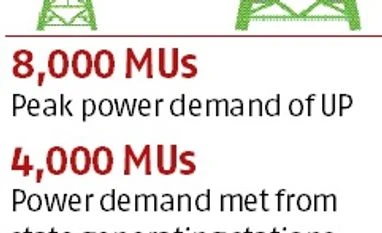
Major power plants from which the state sources electricity are Harduaganj (Rs 5.1/unit), Bajaj Hindustan (4.71/unit), Hindustan Power (Rs 4.7/unit) and Rosa (Reliance Power) (4.33/unit). The state sourced around 4,000 million units (MUs) last year at Rs 4.2-4.9 per unit from these plants.

The high cost of power procurement could be a major problem for debt-ridden discoms, particularly at a time when the new state government has promised 24 hours of power supply.

“When compared to the prices at the short-term or spot power market, UP could have saved Rs 1.5-2 per unit. The savings roughly translate into Rs 500 crore, as against the cost of long-term power,” said a sector executive. The total variable cost paid by UP during April-December 2016 was close to Rs 1,690 crore to procure 3,962 MUs at an average cost of Rs 4.5 per unit from various power plants. Such costs are passed on to the consumers.

Of its total power drawl of 9,281 megawatts (Mw), UP sources 4,225 Mw from inter-state generating stations, 228 Mw through long-term agreements, 364 Mw medium-term agreements, 150 Mw bilateral trade, 26 Mw through shared agreements. The state currently procures no amount of power from power exchanges. 

UP had a peak energy demand of 8,000 MUs in March this year. This could climb up to 10,000 MUs during peak summer months.

Experts pointed out that such long-term PPAs would have made sense four years back when the prices were less, but now a 25-year agreement at over Rs 4 per unit was not prudent. “The power prices due to several variables such as coal prices, increased congestion in network have led to power producers increasing the variable tariff. Spot prices, however, are coming down,” he said.

UP currently procures nothing from spot power market despite 13,500 Mw available at around Rs 2.5 per unit.

The BJP in its poll manifesto promised 24-hour power supply to all by 2019. The five discoms of UP, ailing with a debt totalling Rs 54,000 crore, are under financial restructuring under the UDAY scheme. While the debt has been serviced through bonds, any future funding would depend on the operational efficiency of the discoms.

After he took charge, chief minister Adityanath announced free electricity to the below poverty line (BPL) households and subsidised power up to 100 units of Rs 3 per unit.

One subscription. Two world-class reads.

Already subscribed? Log in

Subscribe to read the full story →
*Subscribe to Business Standard digital and get complimentary access to The New York Times

Smart Quarterly

₹900

3 Months

₹300/Month

SAVE 25%

Smart Essential

₹2,700

1 Year

₹225/Month

SAVE 46%
*Complimentary New York Times access for the 2nd year will be given after 12 months

Super Saver

₹3,900

2 Years

₹162/Month

Subscribe

Renews automatically, cancel anytime

Here’s what’s included in our digital subscription plans

Exclusive premium stories online

  • Over 30 premium stories daily, handpicked by our editors

Complimentary Access to The New York Times

  • News, Games, Cooking, Audio, Wirecutter & The Athletic

Business Standard Epaper

  • Digital replica of our daily newspaper — with options to read, save, and share

Curated Newsletters

  • Insights on markets, finance, politics, tech, and more delivered to your inbox

Market Analysis & Investment Insights

  • In-depth market analysis & insights with access to The Smart Investor

Archives

  • Repository of articles and publications dating back to 1997

Ad-free Reading

  • Uninterrupted reading experience with no advertisements

Seamless Access Across All Devices

  • Access Business Standard across devices — mobile, tablet, or PC, via web or app

Next Story



