Covid impact: India's economy unlikely to see double-digit growth in FY22

Barclays has pegged growth at 7.7 per cent in a bear-case scenario, if the country is hit by a third wave of the pandemic.
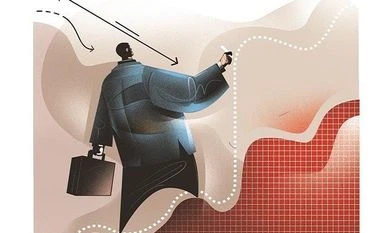
Illustration by Ajay Mohanty
Shrimi Choudhary New Delhi
4 min read Last Updated : Jun 01 2021 | 1:50 AM IST
India’s economy is unlikely to see double-digit growth and may grow between 8 per cent and 9 per cent this fiscal year (2021-22, or FY22), against the estimated 11.5 per cent, according to leading economists and rating agencies.

The downward revision of growth projections to as low as 10 per cent is mostly on account of stringency in restrictions by states, relatively slow vaccination pace, and the possibility of a third wave of the pandemic. However, they say the impact will not be as severe as the first wave, and expect the first quarter to see positive growth. 

Soumya Kanti Ghosh, group chief economic adviser, State Bank of India, said, “It is a good thing that gross domestic product (GDP) contraction of 2020-21 (FY21) is slightly better than expected, but downside of it is that FY22 numbers will now undergo revision and will be in single digits since the base has been significantly revised downwards. Given the pace of vaccination, it is unlikely a large part of the population will be vaccinated by the second quarter of the year. The overall growth prospect looks bleak,”  said Ghosh.

While the country’s GDP has contracted 7.3 per cent in FY21, growth was expected to bounce back in double digits in the current fiscal year as rapid vaccinations were expected to counter the second wave. 

D K Srivastava, chief policy advisor, EY India, said, “With a lower contraction in GDP, as well as gross value added in FY21, the sharp recovery projected for FY22 by a number of agencies, like the International Monetary Fund (IMF) at 12.5 per cent and the Reserve Bank of India (RBI) at 10.5 per cent, may have to be moderated. These projections were done prior to the impact of the second Covid wave. A combination of the Covid second wave and the revised base effect may imply a lower GDP growth for the Indian economy for FY22, which may be in the range of 9-9.5 per cent.”


Alok Sheel, RBI Chair professor in macroeconomics at the Indian Council for Research in International Economic Relations, said, "The provisional estimate of FY21 GDP numbers are slightly better but unlikely to change the big picture. These numbers will need to be counter-balanced by likely downgrades of current GDP growth estimates for FY22. The consensus number for this is now down to below 10 per cent on account of the severity of the second wave of Covid-19. Thus, the overall rebound of the economy through to FY22 is likely to be lower, and the output loss greater than what can be estimated from the IMF April’s forecast.” 

“In view of this, despite Consumer Price Index being on the higher side, the RBI is unlikely to raise interest rates any time soon, even though the current monetary policy regime primarily targets inflation. Also, greater fiscal support might be required to stabilise growth,” added Sheel.

After factoring in recent developments, even most of the global rating and research houses, such as Fitch and Goldman Sachs, have started slashing their India growth estimates for the current fiscal year. 

For instance, Barclays has pegged growth at 7.7 per cent in a bear-case scenario, if the country is hit by a third wave of the pandemic. The economic cost, it believes, could rise by at least a further $42.6 billion, assuming another round of similar stringent lockdowns are imposed across the country for eight weeks later this year.

Devendra Pant, chief economist, India Ratings and Research, said, “As things stand now, the scale, the speed, and the spread of Covid 2.0 has once again given a push-back to the economy. This push-back, however, has not resulted in major supply-side disruption, but the rating agency believes its impact will be felt more via the subdued demand - which will be more pronounced in rural areas due to the spread of infections. So it, therefore, believes the economy will continue to need both fiscal and monetary policy support, at least in the foreseeable future to ensure recovery does not falter on the way to full recovery.”

One subscription. Two world-class reads.

Already subscribed? Log in

Subscribe to read the full story →
*Subscribe to Business Standard digital and get complimentary access to The New York Times

Smart Quarterly

₹900

3 Months

₹300/Month

SAVE 25%

Smart Essential

₹2,700

1 Year

₹225/Month

SAVE 46%
*Complimentary New York Times access for the 2nd year will be given after 12 months

Super Saver

₹3,900

2 Years

₹162/Month

Subscribe

Renews automatically, cancel anytime

Here’s what’s included in our digital subscription plans

Exclusive premium stories online

  • Over 30 premium stories daily, handpicked by our editors

Complimentary Access to The New York Times

  • News, Games, Cooking, Audio, Wirecutter & The Athletic

Business Standard Epaper

  • Digital replica of our daily newspaper — with options to read, save, and share

Curated Newsletters

  • Insights on markets, finance, politics, tech, and more delivered to your inbox

Market Analysis & Investment Insights

  • In-depth market analysis & insights with access to The Smart Investor

Archives

  • Repository of articles and publications dating back to 1997

Ad-free Reading

  • Uninterrupted reading experience with no advertisements

Seamless Access Across All Devices

  • Access Business Standard across devices — mobile, tablet, or PC, via web or app

Topics :Indian EconomyIndia GDP growthFinance Ministry

Next Story



