Over a month since the demonetisation announcement, West Bengal continues to struggle, though tea gardens in Assam have managed to resolve the crisis of paying workers their wages.
Gardens in Assam were able to pay over 90 per cent of the workers during the very week of demonetisation by transferring wages to district magistrates accounts.
Three gardens in the Dooars have shut down, affecting the livelihood of 4,500 workers. The situation is acute in most tea gardens in West Bengal because they lie in an unbanked part of the state.
Only three banks operate in the Dooars, which has 170 tea gardens. Access to banking is also limited in Darjeeling, which has 280-odd gardens. “The cash crunch is acute here,” says Bijoy Gopal Chakraborty, president of the Confederation of Indian Small Tea Growers Associations.
West Bengal Chief Minister Mamata Banerjee has alleged the Centre is discriminating against the state by favouring Assam with cash supplies. “West Bengal’s payments were cut off. Our workers are starving,” Banerjee said on Twitter.
Late in November, the Reserve Bank of India issued a notification instructing tea gardens in West Bengal to draw money from banks on an area-based formula. “Most gardens are labour-intensive and this formula is not sufficient to pay wages to workers,” said S S Bagaria, chairman of the Darjeeling Tea Association.
Although worker unions have protested against demonetisation, they have not struck work. The industry fears disruptions if the cash crunch is not addressed soon.
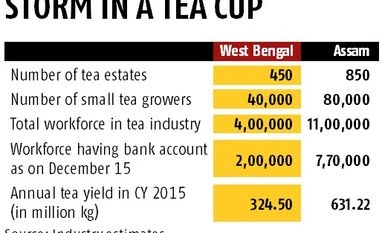
Bank accounts have been opened for 70 per cent of the 1.1 million workers in Assam’s tea gardens, but in West Bengal, 50 per cent of the 400,000 workers now have bank accounts.
Bank accounts are also not serviceable because 60 per cent of gardens in north Bengal are in remote locations.
Industry executives in West Bengal feel the December 30 deadline set by the government for tea gardens to pay workers through cashless methods will not be met.Over a month since the demonetisation announcement, West Bengal continues to struggle, though tea gardens in Assam have managed to resolve the crisis of paying workers their wages.
Gardens in Assam were able to pay over 90 per cent of the workers during the very week of demonetisation by transferring wages to district magistrates accounts.
Three gardens in the Dooars have shut down, affecting the livelihood of 4,500 workers. The situation is acute in most tea gardens in West Bengal because they lie in an unbanked part of the state.
Only three banks operate in the Dooars, which has 170 tea gardens. Access to banking is also limited in Darjeeling, which has 280-odd gardens. “The cash crunch is acute here,” says Bijoy Gopal Chakraborty, president of the Confederation of Indian Small Tea Growers Associations.
West Bengal Chief Minister Mamata Banerjee has alleged the Centre is discriminating against the state by favouring Assam with cash supplies. “West Bengal’s payments were cut off. Our workers are starving,” Banerjee said on Twitter.
Late in November, the Reserve Bank of India issued a notification instructing tea gardens in West Bengal to draw money from banks on an area-based formula. “Most gardens are labour-intensive and this formula is not sufficient to pay wages to workers,” said S S Bagaria, chairman of the Darjeeling Tea Association.
Although worker unions have protested against demonetisation, they have not struck work. The industry fears disruptions if the cash crunch is not addressed soon.
Bank accounts have been opened for 70 per cent of the 1.1 million workers in Assam’s tea gardens, but in West Bengal, 50 per cent of the 400,000 workers now have bank accounts.
Bank accounts are also not serviceable because 60 per cent of gardens in north Bengal are in remote locations.
Industry executives in West Bengal feel the December 30 deadline set by the government for tea gardens to pay workers through cashless methods will not be met.

 "Demonetisation: Cash crunch has hit the tea gardens of Bengal")












