
Early EV adoption, lowering prices and enhancing safety on govt's agenda
NITI rolls out draft battery-swapping policy
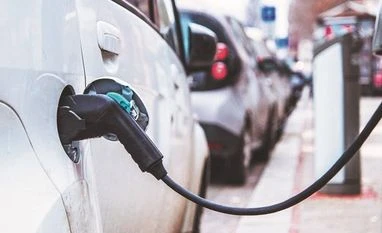 "Early EV adoption, lowering prices and enhancing safety on govt's agenda")
premium
Explore Business Standard
NITI rolls out draft battery-swapping policy
In the midst of frequent incidents of e-vehicles catching fire, the NITI Aayog on Thursday released the much-awaited draft policy on battery-swapping for electric two- and three-wheelers.
Its highlights are lowering prices of electric vehicles (EVs); accelerating the adoption of battery-powered vehicles; addressing anomalies in goods and services tax (GST) rates with regard to batteries, EV supply equipment, and e-vehicles; and enhancing the safety and performance of advanced cell chemistry.
This comes nearly three months after the proposed policy found a mention in Union Finance Minister Nirmala Sitharaman’s Budget speech. The policy is aimed at providing an impetus to India’s transition to green mobility, she had said.
The think tank has invited stakeholder feedback on the draft policy. The last date for comment is June 5.
The policy proposes a staggered roll-out in two phases. The first phase includes developing an ecosystem for battery as a service (BaaS) in metropolitan cities with a population of more than 4 million. The second phase includes developing battery-swapping networks in state capitals and major cities with over 500,000 people.
The NITI Aayog has suggested the incentives for vehicles with fixed batteries be extended to swappable-battery vehicles. The think tank also pushed for fixed-asset concessions for swapping stations.
It suggested the GST Council reduce the differentials between the rates on lithium-ion batteries and electric vehicle supply equipment (EVSE), which are 18 per cent and 5 per cent, respectively.
Industry experts and EV makers said the draft policy was inclusive and addressed most of the critical areas.
According to Sohinder Gill, director general at the Society of Manufacturers of Electric Vehicles (SMEV), the life of the battery and the safety aspects can be better handled in a swap station than inside the e-scooter because the swap station can deploy pre- and post-charge cooling and regulated charging better.
The policy draft is inclusive and promotes interoperability and open architecture. However, the concept of interoperability using the standardised battery needs “to be debated in greater detail as there could be technical challenges as well as the revenue sharing model will have to be worked out carefully to assure ROI to the investments done by the companies,” said Gill.
The draft has been released amid incidents of almost a dozen e-scooters catching fire over the past seven months. The guidelines on battery data sharing, which are part of the draft policy, will provide room for safety and the performance improvement of advanced cell chemistry.
Harshvardhan Sharma, head (auto retail consulting practice), Nomura Research, said the increase in the tax benefits would be “a shot in the arm”.
“That’s more power to people. Also the UIN (unique identification number) is a great step to improve traceability and recycling in parity with global initiatives such as battery passport programmes,” said Sharma.
The policy has laid down safety measures for battery-swapping operators.
“To ensure a high level of protection at the electrical interface, a robust/rigorous testing protocol shall be adopted to avoid any dielectric breakdown, arc phenomenon, or any unwanted temperature rise at the electrical interface. BMS (battery management system) of the battery must be self-certified and open for testing to check its compatibility with various systems, and capability to meet safety requirements,” the policy document said.
The Ministry of Road Transport and Highways has constituted an expert committee to look into battery safety.
“We are aligned with the government on the need to establish standards to promote interoperability in the swapping infrastructure,” said Vivekananda Hallekere, chief executive officer and co-founder, Bounce.
He, however, added the government should form these standards and policies only after testing them and not limiting the assessment to lab tests.
“We urge the government to kindly consider the above points before the policy and standards for battery swapping is formalised,” added Hallekere.
Already subscribed? Log in
Subscribe to read the full story →

3 Months
₹300/Month
1 Year
₹225/Month
2 Years
₹162/Month
Renews automatically, cancel anytime

Over 30 premium stories daily, handpicked by our editors


News, Games, Cooking, Audio, Wirecutter & The Athletic
Digital replica of our daily newspaper — with options to read, save, and share


Insights on markets, finance, politics, tech, and more delivered to your inbox
In-depth market analysis & insights with access to The Smart Investor


Repository of articles and publications dating back to 1997
Uninterrupted reading experience with no advertisements


Access Business Standard across devices — mobile, tablet, or PC, via web or app
First Published: Apr 21 2022 | 11:24 PM IST


