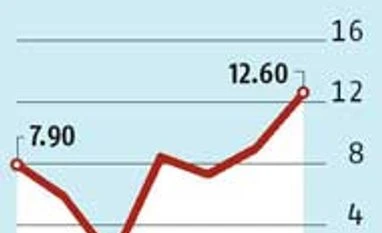
Double-digit expansion in the manufacturing sector during the October-December quarter (Q3) of 2015-16, as shown in the official gross domestic product (GDP) data issued on Monday, has raised several eyebrows.
The Central Statistics Office attributed it to the methodology used, which captures value add arising out of improved corporate efficiencies, instead of actual output as in the case of the Index of Industrial Production (IIP) data. According to CSO, the lower input cost led to improved efficiency in companies, even as sales were down.
Manufacturing growth, by the data, was 12.6 per cent in the quarter and some economists thought this could be an overestimate. Factory production grew nine per cent in the July-September quarter (Q2).
For all of 2015-16, manufacturing is estimated to grow by 9.5 per cent, from 5.5 per cent the year before.
Nominal manufacturing sector growth was lower than the real growth at 10.9 per cent, due to deflation in raw material cost, including in crude oil.
Chief Economic Advisor Arvind Subramanian said the data showed a surprising high, despite the Chennai floods in December.
Nomura said in a note that the significant pick-up in the gross value added appeared a bit inconsistent with the currently low production and capacity utilisation in the sector.
“The surprisingly robust pick-up in manufacturing growth in Q3, relative to Q2, belies the trends available from various high frequency volume-based indicators, including the IIP prints for October-November 2015, said Aditi Nayar, senior economist, ICRA.
T C A Anant, the government’s chief statistician and secretary, ministry of statistics and programme implementation, said the 10.9 per cent nominal manufacturing growth was largely driven by advance filings from the corporate sector, where sales growth was negative but net profit before tax was positive. And, staff cost growth and depreciation was positive for companies, he said.
The new GDP series, 2011-12, captures value added of comoanies instead of actual output, which can result in higher growth if efficiency improves over the corresponding period of the previous year.
“So, here on account of deflation, the intermediate costs are declining faster than sales. The Q3 data is a reflection of this trend,” said Anant.
In October, the IIP growth was 9.9 per cent; in November, it was a negative 3.2 per cent. The December Index of Industrial Production growth figure will be issued on Friday.
Shubhada Rao, chief economist, YES Bank, felt despite taking into account the methodology, double-digit growth in manufacturing was unconvincing.
“One can always argue that the while production could have seen some moderation, the value-add component could still be buffered by improvement in profit margins, on the back of a relative fall in input price inflation vis-à-vis output price inflation. While we acknowledge this possibility, on the ground, signs of such relative price movement are not convincing,” she said.
Ritika Mankar Mukherjee, economist at Ambit Capital, said the new GDP series and the information it was conveying in terms of levels and the direction seemed counter-intuitive.
“This is simply because all our qualitative and quantitative data checks suggest gross domestic product growth decisively decelerated in FY16 versus FY15, while the GDP data is suggesting that growth accelerated in FY16,” she said.

 "Experts question data quality, accuracy")


 Connect with us on WhatsApp