The government is planning to shift to a January-December financial year, and it could happen as early as January 1 next year.
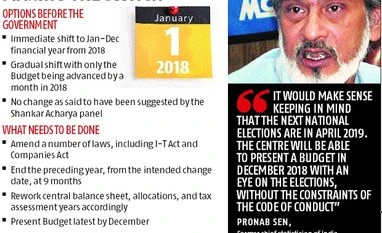
If this happens, the government would have to amend a number of laws, including the Income Tax (I-T) Act and the Companies Act, and cut the current financial year (2017-18) short to three quarters. It would also have to rework the Centre’s balance sheet, start a new assessment year for taxes, and present the Union Budget by December this year.
All this needs to happen in the remaining six months of this calendar year.
“The government is studying all options about the possible change in the financial year, including beginning the next one by January 1, 2018. Nothing has been ruled out,” said a senior official involved in the deliberations.
At present, the financial year begins in April of one year and ends in March the next year. This year, the government advanced the date of presenting the Budget for FY18 from February 28 to February 1.
Another option officials in the Prime Minister’s Office and the finance ministry are considering is a gradual change. For instance, the Budget for the next financial year (FY19) could be presented by January 1, as Business Standard had earlier reported.
The final decision will be made by the Union Cabinet, the official quoted above said.
“If it is to be January 1, 2018, then the decision will have to be taken soon,” he added. The official also said the finance ministry would be able to shorten the changeover process.
Experts were of the opinion that such a change would not be a surprise.
Former Chief Statistician of India and former Planning Commission member Pronab Sen said, “It would make sense keeping in mind that the next national elections are in April 2019. The Centre will be able to present a Budget in December 2018 with an eye on the elections, without the constraints of the code of conduct.”
Sen also said if the government tried to change the financial year in 2019, the Election Commission might question it. Hence, January 2018 seemed a feasible date.
“As far as the preparation is concerned, it should not be a problem. Revised Estimates start coming in from September, so a December Budget is possible,” he said.
The central government had constituted a committee under former chief economic advisor Shankar Acharya to examine the “desirability and feasibility” of having a new financial year. The report hasn’t been made public, but it is learnt that the panel has recommended sticking to the April-March financial year.
However, a NITI Aayog concept paper, written by member Bibek Debroy, favoured the change. Sources have confirmed the change would be applicable to the Centre, the states as well as India Inc.
Last month, Madhya Pradesh became the first state to switch to the January-December financial year. The state’s Budget session will be in December this year or January next year.

 "Fiscal year change might happen as early as 2018")












 Connect with us on WhatsApp