The Union government has decided to launch the second phase of its rural electrification scheme to monitor power supply in about 600,000 villages in real time. Earlier, the government’s focus was limited to the un-electrified villages. It has now decided to keep tabs on power supply to each household.
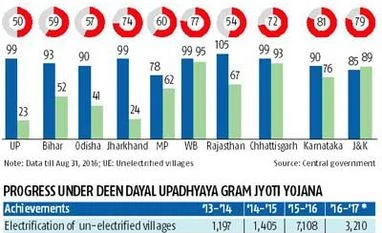
Officials said the Rural Electrification Corporation (REC) was in the final phase of designing the GARV-II monitoring system. Once the system is in place, it will provide a picture of how state governments are spending funds for electrifying villages. It will also provide details of metering, supply and outages for all households. The central government had appointed around 400 field engineers in the first phase of Grameen Vidyutikaran (GARV-I), which was launched on October 14, 2015, to check whether state governments were electrifying villages. This was in the wake of Prime Minister Narendra Modi’s announcement during his first Independence Day speech that the country’s remaining 18,000 villages without power would be electrified by 2018. The government claims it has electrified 10,398 villages till October 13. Electrification, however, does not mean each household has a power connection and a steady supply of current.
An official in the Union power ministry said it had compiled data for 500,000 villages for GARV-II. “Through the new portal, states will be able to see how much power is being provided to each household and identify glitches. Consumers, too, can check the power supply status in their areas. They can lodge complaints with distribution companies as well,” the official said.
The government is planning a massive outreach programme because its poll promise of “24X7 power for all” hinges on complete household electrification, which means villages have to be electrified, metered and energised.
For instance, in Modi’s adopted villages of Jayapur and Nagepur in Varanasi district, the agencies have erected electricity poles and laid transmission lines but are yet to supply electricity. “We receive power for five-six hours daily and pay a fixed amount to the electricity department every month,” said Hira Lal, a 29-year-old resident of Jayapur village that Modi had adopted in the Sansad Adarsh Gram Yojana in 2014. Similarly, Buddhu Ram, a resident of Nagepur village, said they were waiting for the government to connect their houses with the freshly laid electricity cables. “One villager fried his television set when he tried to set up a direct connection on his own,” he said.
Of the 600,000 villages electrified in the past two decades, close to 400,000 are yet to be intensively electrified (IE). IE means electricity infrastructure is accessible to all households in a village. Data suggests around 15 million households do not have a legitimate power connection.
The Union government says providing a metered connection and distribution of power are the responsibilities of the state government and its job is restricted to creation of infrastructure. This dichotomy has left both the states and the Centre sparring over sharing responsibility.
They also differ over sanction of funds. “The state has received Rs 4,115.05 crore against a claim of Rs 5,499.16 crore. For the past two months there has been no disbursement. The total pending disbursal is Rs 2,238 crore,” said Shailendra Yadav, Uttar Pradesh’s power minister in his speech at the power ministers’ conference in Vadodara last week.
Power ministry officials said the new portal would solve this problem by providing details of funds disbursed and sanctioned to states and the amounts utilised. “GARV is an evolutionary process. We did face problems, but those strengthened the system. The most common feedback was lack of data on actual power supply to households,” said Dinesh Arora, executive director, Rural Electrification Corporation (REC), and CEO, REC Power Distribution Company.
In the first phase of the Deen Dayal Upadhyaya Gram Jyoti Yojana (DDUGJY) the government laid stress on electrification of villages. In the second phase, the Centre will focus on energisation of households. Electrified villages such as Jayapur and Nagepur, which were not part of the DDUGJY earlier, have been included.
During discussions at a power ministers’ conference last week, Piyush Goyal, Union power minister, said demarcation of villages for electrification would be abolished. “We have urged the states to aim at power for all. Our sole commitment is to provide 24x7 power. The aim is to electrify 100 per cent of households by March 2019,” Goyal said.
States have agreed to set their own milestones for meeting this target. West Bengal, Haryana, Kerala, Goa, Himachal Pradesh and Tamil Nadu said they would do it by March 2017. For Uttar Pradesh, Jammu & Kashmir and Bihar the target is likely to be 2018.
“GARV signifies transparency meeting technology. It has changed the way we look at rural electrification. Progress in monitoring will empower the consumer,” Arora said.

 "GARV to keep track of rural electrification leap")


 Connect with us on WhatsApp