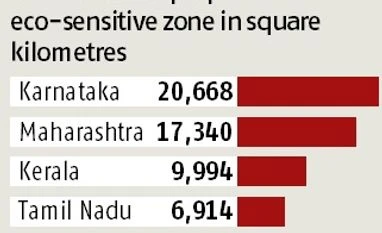
The government has decided to notify 56,825 square kilometres of Western Ghats across six states as eco-sensitive zones where mining, thermal power plants and polluting industries banned and restrictions put on other developing projects and industrial activities. On February 28 the Union environment, forests and climate change ministry put out a draft notification to declare the Eco-Sensitive Zone.
The area spread across Gujarat, Kerala, Maharashtra, Karnataka, Goa and Tamil Nadu is much less than the originally recommended about 77,000 square kilometres as strictly regulated eco-sensitive zone and another 51,600 square kilometres as less onerously restrictive zone by ecological experts in 2011. It is also less than subsequently rationalised figure of 59,940 square kilometres which was recommended by a high-level panel in 2013 in an attempt to keep dense human habitations outside the restrictive zone.
If the proposal sails through in its current shape, it would be the first such eco-sensitize zone set up cutting across state boundaries and bigger from existing ones by multiple orders of magnitude.
The draft will be open to public comments for a period of 60 days after which the government will pass the final notification. With most states already having come on board, sources said, the Union government expects to pass the notification as it is in its draft stage without more changes.
Just as it was done earlier, the government has categorically assured that there will be no displacement of local people from the eco-sensitive zone and existing agriculture and plantation activity will not be affected.
Hydropower projects would be permitted in the area but after a cumulative impact assessment of each project on the flow pattern of the rivers and forest and biodiversity loss and with the condition that a minimum distance between one project and the other is maintained at three kilometre and not more than 50% of the river basin is affected at any time.
The mandatory need for prior informed consent under Forest Rights Act, 2006 from tribal and forest dwellers’ Gram Sabha for undertaking projects and activities has been reiterated.
While the Western Ghats notification is also a matter caught in litigation at present, the new draft could possibly bring to culmination and exercise that began in 2011 when the Madhav Gadgil committee recommended that around 75,000 square kilometres of the Western Ghats across the six states should be put under a strict ecological control regime and remaining parts of the 1,29,037 square kilometres have a lower grade of restriction imposed.
The report met with strong opposition from all state governments and many other stakeholders leading the then UPA government to set up another high-level committee under erstwhile Planning Commission member K Kasturirangan. The committee in 2013 recommended that 59,940 square kilometres of the biodiverse region should be brought under the eco-sensitive regime, though a regime less onerous for developmental projects and industry than that recommended by Gadgil committee.
An attempt to implement this led to a political crisis for the UPA government in Kerala leaving it no option but to back-track. At first Kerala demanded a ground-verification of the boundaries drawn up by the high level committee of the eco-sensitive zone and when permitted to do so, narrowed down the region to be put under restrictions by roughly 4,000 square kilometres. Later other states too got to ‘rationalise’ the boundaries of the eco-sensitive zone based on ground verification. The new draft is a result of this exercise.

 "Govt mulls 56,825-sq km eco-sensitive zone in Western Ghats")












