
Govt panel reiterates need to review open-ended grain procurement policy
The policy has led to mounting food stocks and adversely affected crop diversification, says report
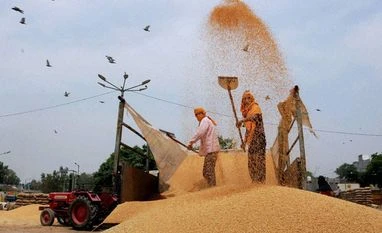 "Govt panel reiterates need to review open-ended grain procurement policy")
premium
WebinarsNew
Deep DiveNew
Explore Business Standard
The policy has led to mounting food stocks and adversely affected crop diversification, says report
With the Food Corporation of India (FCI) sitting on huge stockpiles of foodgrain, the Commission for Agricultural Costs and Prices (CACP), the central government’s farm price support fixing panel, has again strongly recommended reviewing the open-ended procurement policy.
Under the latter, government agencies buy whatever quantity of wheat and rice is brought by farmers into the mandis (wholesale markets), within the stipulated time and which conforms to fixed quality parameters for Central pool. The Commission’s latest report, for the 2020-21 rabi marketing season and issued last week, also favours excluding safflower and nigerseed (ramtil in Hindi) from the Minimum Support Price (MSP) regime. It notes their total production has declined substantially over the past few years.
The panel also wants a comprehensive review of the number of crops under the MSP regime. It has also called for altering the sample size for calculating cost of production, saying the present one undermines the reliability of estimates.
“The government procured a large share of wheat production and market arrivals, about 73 per cent of production in Punjab and 80 per cent in Haryana, in rabi marketing season 2019-20 (April-March). The Commission recommends that the open-ended procurement policy needs to be reviewed,” goes the CACP report.
The policy, it says, has led to mounting food stocks and adversely affected crop diversification. “These excess stocks create storage problems and also high storage and financing costs, leading to high subsidy
burden,” the report notes.
Officials said a big reason for excess stock in government godowns was a growing mismatch between foodgrain required to run the Public Distribution System and the quantity procured. The data shows 78-80 million tonnes (mt) of wheat and rice is procured annually for the central pool, against a requirement of 50-54 mt for the PDS.
Earlier, too, the CACP had recommended a thorough review of the open-ended procurement policy. Its recommendation this year assumes added significance, as the Centre is sitting on huge grain tockpiles and plans to buy more in the coming months.
According to FCI, the country’s foodgrains stock on October 1 was estimated to be 64.23 mt, almost 109 per cent more than the required quantity. And, paddy procured from the 2019-20 crop will start arriving in the coming weeks. The Centre’s target is to buy 42 mt of rice a tenth more than the actual purchase of 2018-19. It had storage capacity of around 88 mt as on August. Of this around 14.5 mt was Cover And Plinth (CAP) storage.
CACP says the economic cost of wheat has increased from Rs 1,908 a quintal in 2013-14 to Rs 2,506 a quintal in 2019-20, an increase of 31.3 per cent. On the other hand, the Central Issue Price, at which wheat is sold through ration shops, has remained unchanged at Rs 200 a quintal from July 2013. This has led to a significant increase in food subsidy. It rose from Rs 92,000 crore in 2013-14 to Rs 171,298 crore in 2018-19. The estimate in this year’s Union Budget was Rs 184,220 crore.
Already subscribed? Log in
Subscribe to read the full story →

3 Months
₹300/Month
1 Year
₹225/Month
2 Years
₹162/Month
Renews automatically, cancel anytime

Premium stories handpicked daily by our editors


News, Games, Cooking, Audio, Wirecutter & The Athletic
Digital replica of our daily newspaper — with options to read, save, and share


Insights on markets, finance, politics, tech, and more delivered to your inbox
In-depth market analysis & insights with access to The Smart Investor


Repository of articles and publications dating back to 1997
Uninterrupted reading experience with no advertisements


Access Business Standard across devices — mobile, tablet, or PC, via web or app
First Published: Oct 28 2019 | 7:47 PM IST


 Connect with us on WhatsApp