Govts must stick to fiscal discipline: Jaitley
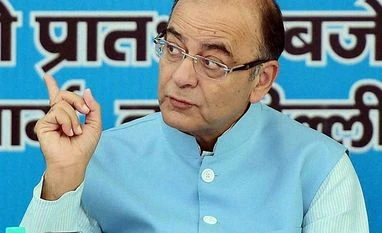
Press Trust of India New Delhi Finance Minister Arun Jaitley on Sunday underlined the need for fiscal consolidation, saying failure in efficient expenditure management on part of governments could lead to Greece-like situation.
Speaking on the occasion of the first Indian Cost Accounts Service Day function, he said in post liberalised era, competitiveness, cost and efficiency management have become the keywords of survival and growth. Jaitley added it is all the more important for the government of a country to have an efficient expenditure management failing which it might face a Greece-like situation.
“What happened in Greece recently, was a direct consequence of the fact that governments there, decided not to live within their means,” he said.
For good governance, Jaitley said, governments need to augment their resources through better revenue collections and manage expenditure well.
He said the only way to stick to fiscal discipline and follow the road of fiscal consolidation is either “earn more or spend less. And the ideal route is to do both. That is what governments are now endeavouring to do,” he added.
Jaitley said the government money is people's money after all and "this money is something which is sacrosanct" and governments must learn the discipline of living within means.
In the inter-connected world, if governments do not live within means, they may face adverse consequences, he said.
"It can lead to outflow of capital...It can have an adverse impact on your currency rates...It can knock off fiscal discipline," Jaitley said.
The government has pegged the fiscal deficit at 3.9 per cent of the GDP for FY 2015-16 and proposed to lower it to 3 per cent by FY 2017-18.
The Minister said that governments need professional advice to avoid overspending.
He asked the officials of the Cost Accounts Service to upgrade their professional skills and expertise in order to play a proactive role in assisting the government in achieving the highest level of cost efficiency in its projects, schemes and operations.
On the occasion, Expenditure Secretary Ratan P Watal said the government has embarked on an important fiscal consolidation programme.
"We have adhered till now to the glide path, but now the challenge or rather the challenges are in the area of capital expenditures, like roads, railways and irrigation. These areas of public investment will require cost control and effective management of expenditure," he said.
Major subsidies, he said, are extremely critical from the viewpoint of fiscal consolidation and are the most important factor in meeting its fiscal targets.
The efforts of the government would be to address this issue with a two pronged strategy, Watal added.
The government is committed to progressively pursue subsidy reforms in a manner that will ensure efficient targeting of subsidies to the poor and needy, while also saving scarce financial resources, he said.

 "Govts must stick to fiscal discipline: Jaitley")

