Gujarat most competitive state, finds NCAER study

West Bengal ranks last on the index, followed by UP, Bihar; these states fare better on sub-indices
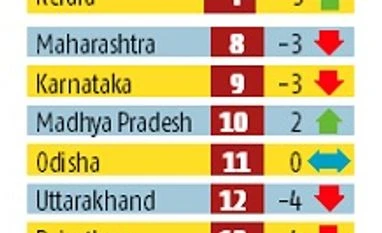
chart, NCAER
Ishan Bakshi New Delhi
Last Updated : Jul 20 2017 | 7:58 PM IST
Gujarat, Delhi, Andhra Pradesh, Haryana, Telangana and Tamil Nadu are the top six states in India for business investment potential, finds a new study by the National Council for Applied Economic Research (NCAER).

The study, which estimates statewise investment potential, ranks their competitiveness on six pillars, namely — land, labour, infrastructure, economic climate, political stability and governance, and business perception.  

Among these six states, Haryana and Telangana have made the most gains on the index over the past year, moving up 12 and 8 spots, respectively. On the other hand, West Bengal, Chhattisgarh, Rajasthan and Uttarakhand have fallen the most, finds the study.

Despite West Bengal ranking last on the index, followed by Uttar Pradesh and Bihar, these states do fare better on sub-indices. Bihar, for example, does better on labour; Uttar Pradesh on land and West Bengal on economic climate. 

Surprisingly, economic power house Maharashtra ranks eighth on the index, down three ranks from last year. Karnataka, the start-up hub, ranks ninth on the index. Delhi fares poorly on governance and political stability.

“On the infrastructure pillar, Maharashtra, Karnataka and Odisha moved closer to the frontier, while Uttarakhand and Assam moved further away. West Bengal made the most gains on the economic climate and governance pillars, while Telangana, Punjab, Haryana and Kerala made significant gains under the perception pillar,” says the report. 

While corruption continues to be a sore area for businesses, the report finds perceptions of corruption seem to be improving, indicating change. The percentage of respondents citing corruption as a constraint for conducting business has fallen from 79 per cent in 2016 to 57 per cent in 2017.

Getting approvals also continue to be a constraint. But, an improvement is seen on this parameter, too, with the percentage of firms reporting it as a constraint having fallen from 72 per cent to 53 per cent. 

“The 2017 N-SIPI perception survey shows that the availability and quality of skilled labour, access to finance and tax policy are the other major issues of concern to businesses,” the report adds.   

One subscription. Two world-class reads.

Already subscribed? Log in

Subscribe to read the full story →
*Subscribe to Business Standard digital and get complimentary access to The New York Times

Smart Quarterly

₹900

3 Months

₹300/Month

SAVE 25%

Smart Essential

₹2,700

1 Year

₹225/Month

SAVE 46%
*Complimentary New York Times access for the 2nd year will be given after 12 months

Super Saver

₹3,900

2 Years

₹162/Month

Subscribe

Renews automatically, cancel anytime

Here’s what’s included in our digital subscription plans

Exclusive premium stories online

  • Over 30 premium stories daily, handpicked by our editors

Complimentary Access to The New York Times

  • News, Games, Cooking, Audio, Wirecutter & The Athletic

Business Standard Epaper

  • Digital replica of our daily newspaper — with options to read, save, and share

Curated Newsletters

  • Insights on markets, finance, politics, tech, and more delivered to your inbox

Market Analysis & Investment Insights

  • In-depth market analysis & insights with access to The Smart Investor

Archives

  • Repository of articles and publications dating back to 1997

Ad-free Reading

  • Uninterrupted reading experience with no advertisements

Seamless Access Across All Devices

  • Access Business Standard across devices — mobile, tablet, or PC, via web or app

Next Story



