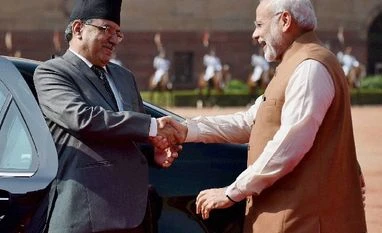
Prime Minister Narendra Modi and visiting Nepalese PM Pushpa Kamala Dahal ‘Prachanda’ on Friday took pains to convey that India-Nepal ties were on the mend following the recent stress in the bilateral relations between the two neighbours.
India and Nepal also signed three agreements, including one where New Delhi will provide a new line of credit of $750 million for post-earthquake reconstruction in Nepal. This is in addition to the $250 billion that New Delhi had committed after the earthquake that had struck Nepal on 25 April. India also offered another line of credit, modalities of which are to be worked out, to assist in development projects in Nepal, including a polytechnic in Dahal’s birthplace in Kaski district.
A key decision after the restricted talks between Modi and Dahal, followed by delegation-level talks, was setting up an oversight committee to speed up the long-delayed road and hydel power projects that India is constructing in Nepal.
Foreign Secretary S Jaishankar said the discussion between Modi and Dahal focused on how to speed up development projects in Nepal. Referring to the impact of the Madhesi protests and blockade of India-Nepal transit points, he said in recent months not much could be done to complete the projects, particularly the Pancheshwar dam project and the first phase of the Terai road project.
The oversight panel will also look into expediting the work on two rail links. These are the Jayanagar-Janakpur-Bardibas and Jogbani-Viratnagar links, where work is hampered by land acquisition and shifting of transmission lines. Three other rail links are also being worked upon, including Kapilvastu-Kusinagar Buddhist circuit link. The two sides also decided to market their Buddhist circuit together to attract more visitors. Dahal sought more transmission lines as well as power from India to tide over Nepal’s short-term power scarcity.
Nepalese PM Dahal had arrived in India on Thursday on a four-day state visit. After their talks, Modi noted the significance of Dahal choosing New Delhi as his first destination for his maiden foreign visit after assuming office last month.
Dahal said he was “overwhelmed by the warm welcome and hospitality” in India. The Indian PM said Dahal has been a “catalytic force of peace in Nepal”. On the contentious issue of implementation of the Constitution, Modi said he hoped Nepal would accomplish it “through inclusive dialogue accommodating the aspirations of all sections of your diverse society”.
The Nepalese PM briefed Modi about the process of implementation of the Constitution. Dahal said his government was making a “serious effort” to bring everyone on board in the interest of all sections of society.
The implementation of the new Constitution in Nepal last year was marked by protests in the Terai region by Madhesis who complained they had been discriminated against and reduced to second-class citizens. The violence had killed 50 protesters and had led to a prolonged blockade of India-Nepal transit routes causing scarcity of essential commodities in Nepal.

 "India-Nepal to set up oversight panel to expedite projects")


 Connect with us on WhatsApp