India's March quarter CAD narrows to 0.1% of GDP
For the entire FY16, CAD stood at $22.1 billion against $26.8 billion for FY15
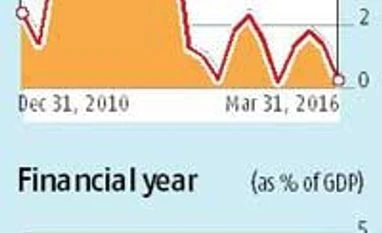
Abhijit LelePress Trust Of India Mumbai India's current account deficit (CAD) declined sharply to $0.3 billion or 0.1 per cent of its gross domestic product (GDP) in the fourth quarter ended March for financial year 2015-16, against $7.1 billion (1.3 per cent of GDP), in the third quarter ended December 2015, on account of a lower trade gap. The CAD was $0.7 billion (0.1 per cent of the GDP) in the quarter ended March 2015 for FY15.
For the entire FY16, CAD stood at $22.1 billion (1.1 per cent of the GDP) against $26.8 billion (1.8 per cent of GDP) for FY15, according to Reserve Bank of India data. Stating that CAD at 1.1 per cent of GDP was a "robust macro economic indicator", Economic Affairs Secretary Shaktikanta Das said efforts would continue on reforms.
Aditi Nayar, senior economist, ICRA, said the CAD for FY16 was broadly in line with expectations. A fall in the services trade surplus and lower remittances eroded a significant portion of the savings arising from the narrowing of the merchandise trade deficit.
The trade deficit in the fourth quarter of FY16 stood at $24.8 billion, compared with $31.6 billion in Q4 of FY15. The deficit was $130.1 billion for FY16, while for FY15 it stood at $144.9 billion.
The balance of payments (BoP) stayed in positive territory with accretion of $3.3 billion to India's foreign exchange reserves in Q4 of FY16. The overall BoP during FY16 moderated to $17.9 billion from $61.06 billion in 2014-15. During the financial year, there was a decline in net invisible receipts, reflecting moderation in both net services earnings and private transfer receipts.
Net foreign direct investment (FDI) inflows during the FY16 stood at $36 billion, by 15.3 per cent over in FY15, RBI said. Portfolio investment, however, recorded a net outflow of $4.5 billion during FY16, against a net inflow of $40.9 billion in FY15.
FDI inflows in the current financial year would top the 15.3 per cent rise in FY16, on the back of reforms and liberalisation of FDI norms, Das said. "Net FDI inflow rose by 15.3 per cent in 2015-16 over the previous year. Should be more this year due to full-year impact of FDI liberalisation in November 2015," he tweeted.
In November, the government had relaxed FDI rules in 15 sectors, including civil aviation, banking, defence, retail and news broadcasting, and eased the process for approvals. It had also raised Foreign Investment Promotion Board (FIPB)'s power to clear FDI proposals to up to Rs 5,000 crore, from Rs 3,000 crore earlier.
Currently, 98 per cent of FDI comes into India through the automatic route, and the rest through FIPB approval. ICRA said the CAD widen modestly from $22 billion in FY16 to $25-30 billion in FY17, nevertheless remaining contained at 1.2-1.3 per cent of GDP. A sustained rise in commodity prices, particularly crude oil would boost the import bill while simultaneously counteracting the risk posed by lower remittances, particularly from West Asia, the rating agency said.

 "India's March quarter CAD narrows to 0.1% of GDP")


