Industrial output expands at 7.1%; March retail inflation eases to 4.28%

Within the IIP, manufacturing grew by 8.7 per cent in February, marginally higher than 8.6 per cent in January
graph
Ishan Bakshi New Delhi
Last Updated : Apr 13 2018 | 12:28 AM IST
The macroeconomic scenario for the country looks favourable for now, with industrial output continuing its healthy expansion, albeit at a slightly lower pace, and retail inflation moderating further. However, there are also some bleak signs, such as a contraction in mining in February and a rise in core inflation in March. Besides, oil prices and minimum support prices may lead to a spike in inflation in coming months. 

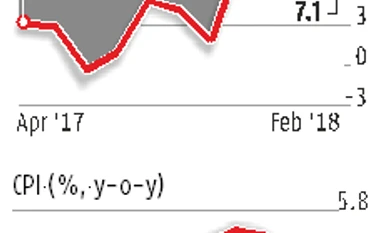
The Index of Industrial Production (IIP) grew at 7.1 per cent in February, driven by strong manufacturing growth, as against 7.4 per cent in January. This is the fourth straight month when the IIP has grown above 7 per cent. Separately, the consumer price index (CPI) inflation rate moderated to 4.28 per cent in March from 4.44 per cent in February, on the back of falling food inflation. This may boost hopes of  better-than-expected gross value added (GVA) growth numbers for the fourth quarter of 2017-18. 

“With IIP growth exceeding 7 per cent for January-February 2018, the outlook for the GVA growth for Q4FY2018 has become brighter,” said Aditi Nayar, principal economist at ICRA. 

Within the IIP, manufacturing grew by 8.7 per cent in February, marginally higher than 8.6 per cent in January, with 15 of the 23 industry groups showing positive growth. The manufacture of other transport equipment showed the highest positive growth of 32 per cent, followed by 26.9 per cent in the manufacture of machinery and equipment, and 19.9 per cent in the case of motor vehicles, trailers and semi-trailers. However, mining output contracted by 0.3 per cent and the pace of electricity generation eased to 4.5 per cent in February from 7.6 per cent in January. 

The capital goods segment, which connotes investment, grew at a robust 20 per cent in February, up from 12.8 per cent in the previous month. 

“Capital goods (segment) has been propped by the vehicle and non-electrical segments, and electrical machinery has negative growth, and hence should be interpreted with caution,” said Madan Sabnavis, chief economist at CARE. 

Others concur. “While the growth of capital goods output has surged in recent months, the year-to-date growth remains moderate at 5.3 per cent. In our view, recovery in investment activity remains limited to certain sectors,” said Nayar. 

Consumer durables and non-durables segments grew by 7.9 per cent and 7.4 per cent, respectively, suggesting the underlying consumer demand in the economy remains healthy, say experts. CARE expects overall growth in IIP to be in the range of 4.6-4.7 per cent for FY18. 

Richa Gupta, senior economist and senior director, Deloitte India, said more clarity was needed from data perspective as positive shoots in the statistics possibly remained affected by favourable base impacts and to some degree may be a result of restocking. 

“As such, in order to maintain the momentum of recovery there is a need to effectively implement structural and infrastructure-related reforms,” Sharma said. 

On the inflation front, while headline inflation moderated, core inflation rose to a 43-month high of 5.4 per cent in March, driven by miscellaneous items and pan, tobacco and intoxicants.  

Food inflation fell to 2.81 per cent in March, down from 3.26 per cent in the previous month, with pulses continuing to contract, even as cereal inflation remained muted. 

“The dip in the inflation for food and beverages in March 2018 was primarily led by vegetables, egg and milk. A continued easing in prices of pulses, sugar and some vegetables would dampen the impact of the seasonal uptick in prices of various perishable items in the ongoing month,” said Nayar. 

Non-food items continued to show high levels of inflation with housing at 8.3 per cent and fuel/light at 5.7 per cent in March. “These two components will continue to witness upward proclivities as oil prices harden in global markets and the Pay Commission impact plays its way out till the statistical base becomes weaker,” said Sabnavis. 

“The announcement of the minimum support price (MSP) for kharif crops will exert pressure in the first half on food prices as well as inflation while the demand pull forces from higher fiscal deficit will play it way in the second half,” he added. 

CARE expects inflation to be at around 5 per cent for this year with greater pressure in the second half. “The surge in global oil prices poses a risk to the trajectory of the CPI inflation in the near term,” said Nayar. ICRA expects the CPI inflation to chart an uptrend in the ongoing quarter to around 5.3 per cent in June 2018.

One subscription. Two world-class reads.

Already subscribed? Log in

Subscribe to read the full story →
*Subscribe to Business Standard digital and get complimentary access to The New York Times

Smart Quarterly

₹900

3 Months

₹300/Month

SAVE 25%

Smart Essential

₹2,700

1 Year

₹225/Month

SAVE 46%
*Complimentary New York Times access for the 2nd year will be given after 12 months

Super Saver

₹3,900

2 Years

₹162/Month

Subscribe

Renews automatically, cancel anytime

Here’s what’s included in our digital subscription plans

Exclusive premium stories online

  • Over 30 premium stories daily, handpicked by our editors

Complimentary Access to The New York Times

  • News, Games, Cooking, Audio, Wirecutter & The Athletic

Business Standard Epaper

  • Digital replica of our daily newspaper — with options to read, save, and share

Curated Newsletters

  • Insights on markets, finance, politics, tech, and more delivered to your inbox

Market Analysis & Investment Insights

  • In-depth market analysis & insights with access to The Smart Investor

Archives

  • Repository of articles and publications dating back to 1997

Ad-free Reading

  • Uninterrupted reading experience with no advertisements

Seamless Access Across All Devices

  • Access Business Standard across devices — mobile, tablet, or PC, via web or app

Next Story



