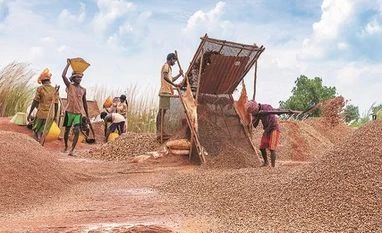
The numbers are still lower than 2020-21, which was an unusual year for MGNREGA work demand due to the nationwide lockdown and unprecedented migration of workers from cities to villages. But compared to the pre-pandemic 2019-20 (FY20), experts say demand still shows a spike. This, claim activists, is a strong signal.
Even though the economic situation might have improved in rural areas, it still hasn't returned to its normal levels. A large number of casual workers are still looking for temporary jobs under schemes like MGNREGA.
Which brings the question of more funding to the fore. Of the budgeted Rs 73,000 crore for the Centre's flagship scheme, around Rs 55,915.31 crore (approximately 77 per cent of the budget) has already been exhausted in the first five months of FY22.
Some reports say an additional Rs 25,000 crore might be required in the current fiscal year to meet work demand requirement, in addition to the budgeted Rs 73,000 crore.
Similarly, in August, around 24.36 million households had demanded work under MGNREGA - 0.21 per cent more than the previous year, but nearly 68 per cent more than the same month in 2019.
In terms of person-days of work generated, the data from the website shows that even though work generated - compared to 2020 - has been less from May to August, it has been significantly higher, compared to the same months in 2019.
“It is obvious that the MGNREGA work demands are significantly higher than FY20. However, the budget allocated for the scheme is the same as FY20. This is clearly an indication that the Centre needs to get its numbers right and allocate more funds for the smooth running of the scheme. Also, it is important to note that there has been a significant delay in the release of wages this year, which could have slowed the processes at the grassroots level. In reality, actual demand could be significantly more than what it shows on the MGNREGA website. There is potential for greater employment generation,” says Debmalya Nandi, social worker and member of MGNREGA Sangharsh Morcha.
He has seen inadequate work being sanctioned by different state gram panchayats and workers not being engaged sufficiently.
“The official data also shows that the leaks have been high (according to some media reports) in the past four years. While it could be concluded that the government needs to allocate more budget for MGNREGA, it also needs to streamline payments. It has to put in place stringent systems locally to ensure work demands are accepted by officials,” says Nandi, adding that the government can try out a Kaam Maango Abhiyan (a nationwide work demand campaign) and focus on large-scale employment generation after the monsoon to alleviate rural distress.
LABOUR OF LOVE
- Renamed MGNREGA in 2009, it guarantees at least 100 days of employment in a fiscal year to unskilled rural households at a pre-determined minimum wage rate
- MGNREGA is widely attributed to have provided employment opportunities to millions of workers who shifted back to their hometowns and villages after having lost jobs in the wake of Covid-19 in 2020
One subscription. Two world-class reads.
Already subscribed? Log in
Subscribe to read the full story →
Smart Quarterly
₹900
3 Months
₹300/Month
Smart Essential
₹2,700
1 Year
₹225/Month
Super Saver
₹3,900
2 Years
₹162/Month
Renews automatically, cancel anytime
Here’s what’s included in our digital subscription plans
Exclusive premium stories online
Over 30 premium stories daily, handpicked by our editors


Complimentary Access to The New York Times
News, Games, Cooking, Audio, Wirecutter & The Athletic
Business Standard Epaper
Digital replica of our daily newspaper — with options to read, save, and share


Curated Newsletters
Insights on markets, finance, politics, tech, and more delivered to your inbox
Market Analysis & Investment Insights
In-depth market analysis & insights with access to The Smart Investor


Archives
Repository of articles and publications dating back to 1997
Ad-free Reading
Uninterrupted reading experience with no advertisements


Seamless Access Across All Devices
Access Business Standard across devices — mobile, tablet, or PC, via web or app
)