The revised definition of gross domestic product (GDP) and the new base year has pushed up India’s economic growth in 2012-13 and 2013-14, compared to the older series, surprising many.
A small part of this is accounted for by the movement of indirect taxes and subsidies.
Besides, manufacturing rose 5.3 per cent in 2013-14 against contraction in the older series as some services that go in promoting factory production by large corporates are included only in this output.
In the new definition of the economic growth, GDP is estimated at market prices, which includes indirect taxes but excludes subsidies. Earlier, GDP growth was estimated at factor cost, which excludes indirect taxes but includes subsidies.
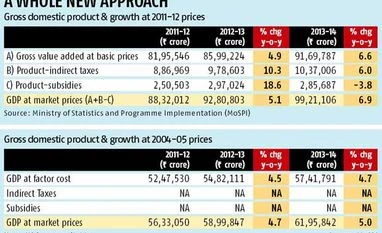
Taking the old definition and base of 2004-05, India’s GDP growth stood at 4.5 per cent in 2012-13 and 4.7 per cent in 2013-14. However, the new series put GDP growth at 5.1 per cent for 2012-13 and 6.9 per cent for 2013-14. GDP at factor cost is now passé and will not even be mentioned by the government in future statements. GDP at market prices was recorded in the past as well even though it was not counted while calculating economic growth.
In place of GDP at factor cost, gross value added (GVA) at basic prices will be used now.
The difference between GDP at factor cost and GVA at basic prices is that production taxes are included and production subsidies excluded from the latter.
Production taxes and subsidies are different from product taxes and subsidies.
“These (production taxes) are imposed even if the products are not produced, such as property. However, excise duty, value added tax etc are all product taxes. Similarly, product subsidies would not include interest subsidies, which will form part of production subsidies,” explained National Statistical Commission chairman Pronab Sen. Now, GDP at market prices would come by adding product taxes and deducting product subsidies from GVA at basic prices.
GVA at factor cost rose 4.9 per cent in 2012-13 and 6.6 per cent in 2013-14.
These subsidies at product prices rose 18.6 per cent (at constant prices) in 2012-13 and declined 3.8 per cent in 2013-14.
On the other hand, indirect taxes on product rose 10.3 per cent in 2012-13 and six per cent in 2013-14.
The net result was that GDP at market prices rose 5.1 per cent in 2012-13 and 6.9 per cent in 2013-14.
The 0.2 per cent point addition in 2012-13 (from GVA at basic prices) and 0.3 percentage point expansion in 2013-14 was accounted by movement of subsidies and indirect taxes. It should be noted that product subsidies, which are excluded from new definition of GDP, declined 3.8 per cent in 2013-14 year-on-year.
Within GDP as well, composition of various sectors have changed. For instance, the share of manufacturing rose from 12.9 per cent in the old base to 18 per cent in the new series for 2013-14. The government wants to increase the share from 16 per cent to 25 per cent in a decade. This was because certain services that go into after product moves out of factory are included in the manufacturing.
Explaining this, Sen said two kinds of approaches — establishment and enterprises — are used in calculating manufacturing production. Till now, only establishment approach was used which means calculating production plant by plant.
On the other hand, in enterprises approach the activities at headquarters are taken into account. For instance, after an item is produced, various marketing and sales promotion efforts go at headquarters level.
“All these have been taken into manufacturing,” Sen, former chief statistician, said.
In the new GDP data, establishment approach is used for small companies as they have a few plants or sometimes a single plant. But, for large corporates, enterprises approach is used.

 "With new definition & base yr, GDP rises")


