India’s so-called “blue economy”, which involves harnessing the vast resources of the ocean in a sustainable, equitable and efficient way, would quadruple by 2050, estimated Chief of Naval Staff (CNS) Admiral Karambir Singh while explaining how the Indian Navy supports and safeguards this economy.
Ocean-based trade currently contributes about 4 per cent of India’s Gross Domestic Product. The CNS estimated that two-thirds of India’s food production would be farmed from the seas and clean offshore wind energy would be the leading power generation technology in the next few years.
With 80 per cent of the world’s population residing within 200 km of the coast, by 2030 the global population would require about 30 per cent more water, 40 per cent more energy and 50 per cent more food.
Singh said India could only achieve its goal of emerging as a $5-trillion economy if it moved outwards and tapped the oceans. With the Extended Continent Shelf likely to be added to our current Exclusive Economic Zone (EEZ), this will make India’s sea area as large as its land area.
“This, combined with India’s location, a 7,516-km-long coastline, 14,500 km length of navigable inland waterways, and 1,382 islands, I think the seas must become India’s ‘opportunity region’ in the coming future,” he said.
Elaborating further, he said that India fished only 70 per cent of 5.3 million metric tonnes in its maritime zone. About 90 per cent of this catch comes from fishing in waters up to 50 metres, which meant deep-sea fishing provides large opportunities.
The CNS said India currently plans to tap just one-tenth of its 300-gigawatt offshore wind energy potential. The Bay of Bengal has 8 per cent of the world’s coral reefs and 12 per cent of all mangroves, providing opportunities for coral reef tourism.
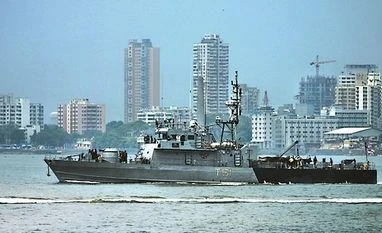
Singh said the navy safeguards this blue economy in three ways. First, through comprehensive Maritime Domain Awareness (MDA), which means monitoring and understanding what is happening at sea. This remains a challenge, given India’s EEZ.
Second, the navy coordinates closely with national and international maritime agencies to close gaps in understanding, policing and jurisdiction. The CNS cited last Sunday’s drug haul near Minicoy inland (part of the Lakshadweep archipelago), which involved close coordination with various national agencies and careful monitoring of the linkages between drugs and terror.
Third, the navy supports littoral nations in developing their maritime capability. “We support partner nations through construction of patrol vessels, installation of radar chains, training support, information sharing, joint EEZ surveillance, etc,” he said.
Singh also explained three measures that India used to discharge its role as “an element of the blue economy”.
First, through the navy’s strong hydrographic capability that enables it to teach smaller island nations to map their EEZ. Second, by supporting ship-building through “an indigenous ship-building ecosystem, with know-how, expertise and skills that pool into the wider ship-building industry”.
The third area is data collation. Naval assets support oceanographic data collection that pools into national marine data. India is lending support to the national Deep Ocean Mission, which aims to send a manned mission to 6,000 metres depth for surveying poly-metallic nodules, hydrothermal deposits and deep-sea biodiversity.

 "Navy outlines plan to quadruple India's blue economy by the year 2050")











