
NITI Aayog to suggest development map for Rajasthan
The team is also expected to highlight state's not so good record on managing the fiscal deficit
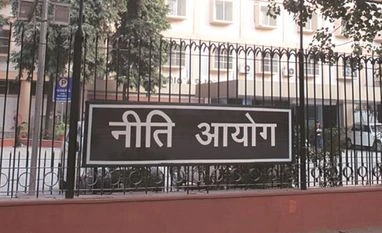 "NITI Aayog to suggest development map for Rajasthan")
premium
WebinarsNew
Deep DiveNew
Explore Business Standard
The team is also expected to highlight state's not so good record on managing the fiscal deficit
After doing so for Uttar Pradesh, the NITI Aayog, is to prepare development maps and growth strategies for Rajasthan, Gujarat and Punjab.
A high-level team from the Aayog is expected to visit Rajasthan in a few days for extensive discussion with state officials.
For UP, a sub-committee under the Aayog of senior officials from the state and central government has suggested overhaul of the state's bureaucracy by merging or scrapping departments, including health and education.
In the case of Rajasthan, officials said the Aayog and its team are expected to highlight the state's impressive performance in solar energy, agriculture, the 'Bhama Shah' project (direct benefits transfer of subsidies and other welfare delivery services) and e-mitra.
The team is also expected to highlight the state's not so good record on managing the fiscal deficit, up from 3.1 per cent of Gross State Domestic Product in 2014-15 to 10 per cent and 5.6 per cent in 2015-16 and 2016-17, respectively. The slow pace of urbanisation in the state is also expected to be discussed.
NITI Aayog, which replaced the Planning Commisison, has adopted 'cooperative federalism' as a guiding principle. It has had numerous discussions with state governments — on framing a model land leasing law, ranked them on various parameters, restructured of centrally sponsored schemes and so on.
For UP, the Aayog has pointed to separation in its health department between the department of medical education and department of medical health & family welfare. In addition, multiple agencies are responsible for implementing initiatives in different areas of health — NRHM, health systems development, state innovations in family planning services, etc.
"Fragmentation of this nature leads to coordination issues and makes it difficult to establish accountability, due to multiple channels of reporting," the Aayog said.
Already subscribed? Log in
Subscribe to read the full story →

3 Months
₹300/Month
1 Year
₹225/Month
2 Years
₹162/Month
Renews automatically, cancel anytime

Premium stories handpicked daily by our editors


News, Games, Cooking, Audio, Wirecutter & The Athletic
Digital replica of our daily newspaper — with options to read, save, and share


Insights on markets, finance, politics, tech, and more delivered to your inbox
In-depth market analysis & insights with access to The Smart Investor


Repository of articles and publications dating back to 1997
Uninterrupted reading experience with no advertisements


Access Business Standard across devices — mobile, tablet, or PC, via web or app
First Published: Jun 30 2017 | 2:22 AM IST


 Connect with us on WhatsApp