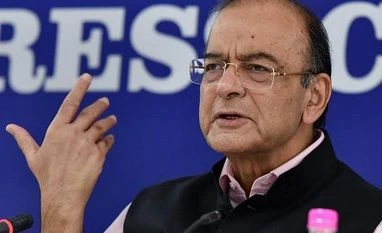
Personal income tax (I-T) collection rose 20.2 per cent and corporation tax 19.5 per cent in the first seven months of the current financial year (2018-19 or FY19), over the corresponding period of the previous year (2017-18 or FY18), said Finance Minister (FM) Arun Jaitley on Thursday. For this, he credited the government decision to demonetise high-value currency notes on November 8, 2016.
In the Budget for FY19, the government targeted 19.88 per cent growth for personal I-T and 10.15 per cent growth for corporation tax.
Quoting a plethora of statistics, Jaitley said on his Facebook page in the two years before demonetisation — 2014-15 (FY15) and 2015-16 (FY16) — direct tax collections increased 6.6 per cent and 9 per cent, respectively. Since demonetisation, the increase has been 14.6 per cent in 2016-17 and 18 per cent in 2017-18.
He also said the formalisation of the economy because of demonetisation and the goods and services tax (GST), rolled out in July 2017, had yielded growth in indirect tax collection as well.
“In FY15, the indirect tax-to-gross domestic product (GDP) ratio was 4.4 per cent. Post-GST (sic), it has climbed up by at least 1 percentage point to 5.4 per cent,” he said in his post, “Impact of Demonetisation”.
He said despite an annual I-T relief of Rs 970 billion to the smaller taxpayers and a Rs 800-billion to the GST assessees, tax collections have gone up.
The finance minister also said the GST had made it increasingly difficult to evade taxes. The indirect tax-to-GDP ratio had gone up to 5.4 per cent since the GST roll-out, from 4.4 per cent in FY15.
Tax rates — both direct and indirect — have been cut, he said, citing the example of 334 commodities on which the pre-GST effective levy was 31 per cent.
Jaitley said the formalisation of the economy had prompted the government to earmark more resources for the welfare and infrastructure development.
In FY18, 68.6 million tax returns were filed — an increase of 25 per cent over the previous year.
As of October 31 this year, 59.9 million tax returns have been filed — an increase of 54.33 per cent over the previous year. About 8.6 million new taxpayers were added this year.
When the Prime Minister Narendra Modi-led government came to power in May 2014, the number of I-T filers was 38 million. Now, the number has reached 68.6 million.
“By the time the first five years of this government are over, we will be close to doubling the assessee base,” he said.
The FM said another success of demonetisation was the push to digitisation. With paucity of cash in the economy immediately after Rs 500 and Rs 1,000 notes were demonetised, indigenous cards and payment systems such as RuPay and Unified Payments Interface (UPI) have overtaken Mastercard and Visa.
“Today, Visa and Mastercard are losing market share to indigenously developed payment system. The share of UPI and RuPay has reached 65 per cent of payments through debit and credit cards,” Jaitley said.
He also dismissed those who criticised demonetisation as “ill-informed” for saying the entire demonetised cash was deposited in banks. Confiscation of currency was not an objective of the note ban, he said.
“Getting it into the formal economy and making the holders pay tax was the broader objective. The system required to be shaken up in order to make India move from cash to digital transactions. This would obviously have an impact on higher tax revenue and a higher tax base,” Jaitley said.

 "Note ban expanded tax base, led to digitisation, says Arun Jaitley")












 Connect with us on WhatsApp