After 17 years of debate, the Goods and Services Tax (GST) came into effect all over India, this day, an year ago (1 July 2017).
The formation of the new indirect tax regime, that subsumed more than a dozen central and state levies, started way back in 2000 when the then prime minister, Atal Bihari Vajpayee, set up a committee headed by then finance minister of West Bengal, Asim Dasgupta, to design a GST model.
What followed was years of consultations and debates between the union government and states to build a consensus about this mega reform. There was strong opposition to the roll out of GST, especially during the tenure of prime minister Manmohan Singh when Gujarat government, led by Narendra Modi objected to GST's roll out citing poor IT infrastructure.
Ironically, it was the Narendra Modi government at the Centre which passed the Constitutional Amendment Bill for GST in August, 2016.
The government took the "money bill route" to get the bill cleared, apparently as it did not had a majority in the Rajya Sabha. The opposition had criticised the move saying "government has cheated the people by bringing the GST bills as a money bill”.
The real challenge, however, lied with the government's ability to implement the law by overhauling the whole taxation process within the set time frame to meet the deadline for roll out, July 2017.
The hasty implementation of the law led to several teething issues during the initial days.
Small business had to face difficulties during the first few months under the new tax regime. With the entire compliance machinery dependent on the technology portal, compliance became the largest hurdle for smaller businesses. Multiple tax slabs also complicated the compliance process. At present GST has five tax slabs of 0, 5 per cent, 12 per cent, 18 per cent and 28 per cent.
Not only businesses, the government also had to face multiple difficulties. The fact that the technology portal was ill-equipped to handle the load, government had to regularly extend compliance timelines. Owing to a variety of reasons, the GST Council also had to make multiple changes in the rates on many products, increasing difficulties for both businesses and tax machinery. While GST was supposed to be a simpler tax, the multiplicity of slabs and the glitches in the systems made its administration and compliance complex.
The one area that India was successful while implementing GST was containing inflation. As implementation of GST led to rise in inflation in most of the countries where it was launched, it was widely believed that India would see a similar side-effect of the law. But thanks to the much-criticised multi-slab structure, the taxes under GST remained close to the existing rates and hence prevented inflation from rising.
A year later, the new tax system appears to be a lot more settled but there's still a long way to go for it to become a truly comprehensive tax.
The World Bank, in a report released in March, said the GST system in India was among the most complex in the world with not only one of the highest tax rates but also one of the largest number of tax slabs.

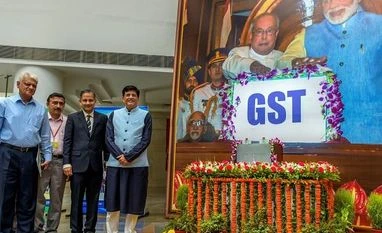 "GST turns one: Leaving the birth pangs behind, it learns how to walk")












