
Ravi Shankar Prasad says AI has massive potential to generate development
Prasad further said AI would become "meaningful" only when it brings in a "palpable improvement" in the quality of life of ordinary Indians
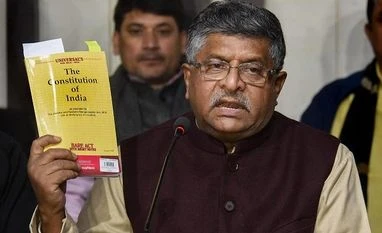 "Ravi Shankar Prasad says AI has massive potential to generate development")
WebinarsNew
Deep DiveNew
Explore Business Standard
Prasad further said AI would become "meaningful" only when it brings in a "palpable improvement" in the quality of life of ordinary Indians
Artificial intelligence (AI) has massive potential to generate development and India is well-poised to tap into the opportunity with its large pool of skilled professionals, IT Minister Ravi Shankar Prasad said on Monday.
Speaking at the 'RAISE 2020 Summit', Prasad also said the proposed data protection legislation will give a big fillip to the country's data economy.
Prasad further said AI would become "meaningful" only when it brings in a "palpable improvement" in the quality of life of ordinary Indians.
"Technology keeps on evolving... we welcome AI because it has enormous potential to generate development and also bring in further equity and delivery...We also want AI to further promote that inclusive character of development," he said.
Stating that Indian IT companies are globally competitive, Prasad exuded confidence that the country's large pool of skilled professionals would help manage not only India's AI ecosystem but also that of the world.
The minister cited the examples of Ayushman Bharat, GST and direct benefit transfer (DBT) to highlight how the government has used technology to deliver public services.
"In the direct benefit transfer, we have transferred close to USD 172 billion into more than 370 million bank accounts of poor for various welfare measures and we have saved close to USD 23 billion, which used to be pocketed by middlemen... About 10.6 million farmers (are) using e-market to sell their farm produce," he said.
Prasad said the government is crafting the data protection law after a wide consultation process.
He added that the bill -- expected to be passed by Parliament soon -- is an amalgamation of efforts to ensure data privacy, safety, security as well as data innovation.
"And most importantly, it will give a big fillip to the data economy, which India is poised to offer...India's application of AI will become a beacon for the world," he emphasised.
Speaking at the summit, Raj Reddy, former co-chair, US President's Information Technology Advisory Committee, said the government, industry and academia should work together to create the necessary Indian language datasets, translation systems and dialogue apps.
(Only the headline and picture of this report may have been reworked by the Business Standard staff; the rest of the content is auto-generated from a syndicated feed.)
First Published: Oct 05 2020 | 11:24 PM IST


 Connect with us on WhatsApp