RBI's payout unlikely to plug the huge govt revenue hole created by Covid

Last year the RBI's board approved a record payment of Rs 1.76 trillion ($23.5 billion) to the government, which included Rs 1.23 trillion as dividend and Rs 526.4 billion from its surplus capital

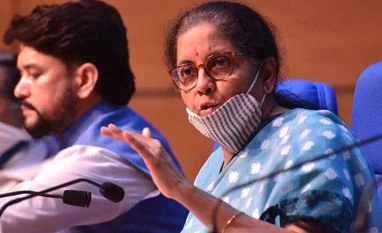
Finance Minister Nirmala Sitharaman
With limited alternative revenue sources and the budget gap in the first three months of the fiscal year already standing at 83% of the full-year target, calls are growing for the RBI to directly finance the fiscal deficit.
Anirban Nag | Bloomberg
3 min read Last Updated : Aug 14 2020 | 8:43 AM IST
India’s Finance Minister Nirmala Sitharaman can expect another payout from the central bank in coming weeks, but it’s unlikely to plug a huge government revenue hole created by the pandemic.

The Reserve Bank of India’s board, led by Governor Shaktikanta Das, is meeting Friday, and since August is typically the month the central bank makes its annual transfer to the government, expectations are running high that the RBI will disclose its dividend payout.

Last year the RBI’s board approved a record payment of Rs 1.76 trillion ($23.5 billion) to the government, which included Rs 1.23 trillion as dividend and Rs 526.4 billion from its surplus capital. This year, New Delhi has budgeted for a Rs 600 billion transfer, but local media has speculated authorities are expecting more. Analysts and economists are forecasting anything between 400 billion to 1 trillion rupees.


“Our estimate is for Rs 400-500 billion, so it may fall short of the budgeted levels and thereby adding to fiscal pressures,” said Kanika Pasricha, an economist at Standard Chartered Plc in Mumbai.​

India's central bank approved record transfer to govenment last year

Revenue is falling well short of projections as India’s economy heads for its first full-year contraction in more than four decades. At the same time, the government is being forced to spend more to cushion the blow from the pandemic, straining the budget deficit. The government can help bridge the funding gap by drawing more cash out of the central bank, sell state assets and push up borrowing, which is already at a record high.

Standard Chartered predicts the government’s fiscal deficit will surge to 7.4% of gross domestic product in the current fiscal year, more than double the government’s original target.

With limited alternative revenue sources and the budget gap in the first three months of the fiscal year already standing at 83% of the full-year target, calls are growing for the RBI to directly finance the fiscal deficit. Central banks in Indonesia and the Philippines have already adopted this approach, but those opposed to debt monetization in India cite risks to the nation’s credit rating and inflation, which is already above the RBI’s 2%-6% target range.


"To make up for that shortfall the government and the RBI need to go in for monetization of fiscal deficit. A transfer of few hundred billion rupees of additional reserves from the central bank is unlikely to move the needle much for government finances, in our view." -- Abhishek Gupta, India economist

The RBI pays dividends to the government every year, based on the profits from its investments, both home and abroad, and printing of notes and coins. In recent years the government has been putting pressure on the central bank to increase its payouts. An expert committee last year recommended the central bank could part with some of its surplus capital.

“We expect dividend of Rs 1.05 trillion based on higher income from domestic assets,” said A Prasanna, chief economist at ICICI Securities Primary Dealership in Mumbai. He expects the central bank to set aside more than 700 billion rupees to maintain capital buffers.

--With assistance from Suvashree Ghosh.

One subscription. Two world-class reads.

Already subscribed? Log in

Subscribe to read the full story →
*Subscribe to Business Standard digital and get complimentary access to The New York Times

Smart Quarterly

₹900

3 Months

₹300/Month

SAVE 25%

Smart Essential

₹2,700

1 Year

₹225/Month

SAVE 46%
*Complimentary New York Times access for the 2nd year will be given after 12 months

Super Saver

₹3,900

2 Years

₹162/Month

Subscribe

Renews automatically, cancel anytime

Here’s what’s included in our digital subscription plans

Exclusive premium stories online

  • Over 30 premium stories daily, handpicked by our editors

Complimentary Access to The New York Times

  • News, Games, Cooking, Audio, Wirecutter & The Athletic

Business Standard Epaper

  • Digital replica of our daily newspaper — with options to read, save, and share

Curated Newsletters

  • Insights on markets, finance, politics, tech, and more delivered to your inbox

Market Analysis & Investment Insights

  • In-depth market analysis & insights with access to The Smart Investor

Archives

  • Repository of articles and publications dating back to 1997

Ad-free Reading

  • Uninterrupted reading experience with no advertisements

Seamless Access Across All Devices

  • Access Business Standard across devices — mobile, tablet, or PC, via web or app

Topics :CoronavirusNirmala SitharamanFiscal DeficitReserve Bank of India RBIindian governmentTax RevenuesShaktikanta DasIndia GDPglobal central banks

Next Story





