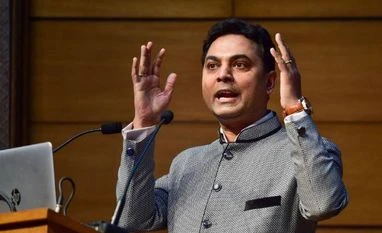
Chief Economic Advisor (CEA) Krishnamurthy Subramanian on Monday said the government is converting the Covid-19 crisis into an opportunity to have labour-intensive economic growth. This, he said, is a shift from jobless growth seen in the past.
He said reforms being undertaken by the Narendra Modi government would benefit the silent majority, but the ‘status-quoist minority’ is more vocal.
Addressing a Confederation of Indian Industry event, Subramanian said, “The agricultural changes, micro, small and medium enterprise (MSME) definitional changes, production-linked intensive (PLI) scheme, labour reforms are all an attempt to change the macroeconomic configuration of the economy towards those sectors which are more employment-intensive, especially agriculture and manufacturing."
This is important because sustained growth can only happen through robust job creation, not through jobless growth, he said.
"Jobless growth episodes peter out, while growth accompanied by job creation puts money in the hands of people. This creates demand for products and services, and eventually leads to sustained growth," he emphasised.
A lot of economic growth has not been that labour-intensive in the past 50 years, said Subramanian.
"For sustained growth to happen, demand must be created. In countries that have grown at 5 per cent for a decade, they have seen increase in wages and employment. People had disposable income and that is how growth was sustained," he said.
Subramanian said the Covid-19 pandemic is different from the earlier crises. While the earlier crises reflected an overheating of the economy and consequently high current account deficit (CAD) and inflation, the current crisis is about underheating of the economy and consequently current account surplus. The economy may have this surplus in 2020-21, even if the remaining three quarters do not repeat the $19.8-billion excess amount in current balance in the first quarter.
He rolled out statistics to buttress his point: CAD was around 6 per cent of gross domestic product during the taper tantrum crisis and inflation was in double digits.
Once this difference was understood, reforms were specifically designed to target agriculture and manufacturing to create sustained growth, he added.
The impact on economic growth due to lockdown necessitated by Covid-19 is a short-term phenomenon. The more noticeable aspect was to understand the medium- and long-term impact of the crisis on economic expansion.

 "Reforms to unleash employment-led growth vs jobless expansion earlier: CEA")











