Home / Economy / News / Saubhagya: This is how Modi govt's many 'power for all' schemes have fared
Saubhagya: This is how Modi govt's many 'power for all' schemes have fared
As govt launches the Rs 16,000-crore Saubhagya scheme for complete electrification of India by Dec 2018, we look at the many old schemes on this with many different price tags
premium
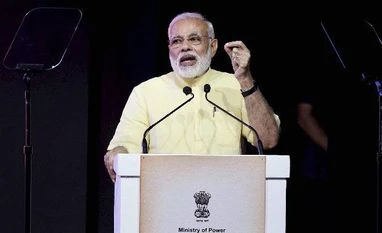
Prime Minister Narendra Modi speaks at the launch of Sahaj Bijli Har Ghar Yojana or ‘Saubhagya’, to supply electricity to poor households, in New Delhi (Photo: PTI)
Earlier, you had GARV, GARV-II, IPDS, DDUGJY, UDAY and UJALA. And now, SAUBHAGYA has joined the long list of schemes promising ‘power for all’. Right since the government under Narendra Modi took charge at the Centre in May 2014, energy access has been the clarion call.
In the first Union Budget that the Modi government presented in 2014, rural and urban electrification had seen a major thrust, along with a name change and allocation boost. Strict targets were part of these two schemes – Integrated Power Development Scheme (IPDS) and Deen Dayal Upadhyaya Grameen Jyoti Yojana (DDUGJY).
Of the unelectrified 18,000 villages, 14,483 are mentioned as electrified on the GARV dashboard, which captures real-time data for rural electrification. However, while the speed of progress in powering villages is laudable, household electrification data remain dismal. Of the 170 million households, 40 million remain to be fully electrified, show government data. Also, 24x7 power is still a far cry even for the electrified households.
So far, no clause in the rural electrification programme promises 24-hour power supply. Even SAUBHAGYA doesn’t promise to monitor the quantum or quality of power supply, despite the government claiming that India is a power-surplus country.
In this year’s budget, the allocations to IPDS and DDUGJY were the highest ever. Under IPDS, grant is given to states after they submit their proposal for urban power reforms. According to its website, the total grant from the Government of India to the scheme stands at Rs 16,019 crore. Of this, the total released grant is only Rs 3,728 crore – that when, at 60 per cent, budgetary support to IPDS is the highest for any Centre-sponsored programme.
The government said is a statement: “The total outlay for the SAUBHAGYA project is Rs 16, 320 crore, while the Gross Budgetary Support (GBS) is Rs 12,320 crore. The outlay for rural households is Rs 14,025 crore, while GBS is Rs 10,587.50 crore. For urban households, the outlay is Rs 2,295 crore, while GBS is Rs 1,732.50 crore. The Government of India will largely provide funds for the scheme to all states/UTs.”
In the Union Budget 2017-18, IPDS was allocated Rs 5,821 crore and DDUGJY received a budgetary allocation of Rs 4,814 crore.
Basically, the new scheme would provide more central funds, mostly for subsidy. Subsidising electricity may not be wrong, especially for those who cannot pay. But it should not be forgotten that it is the years of subsidised electricity and fund-pumping by the Centre that has crippled the country’s power distribution sector.
Battling debt and beleaguered operations, power distribution companies (discoms) across India are still trying to resurrect themselves through the reform programme UDAY. These states were expected to get on the operational reform path after a debt restructuring by this year. Given a slow progress in loss reduction and operational turnaround, central funds could lead these discoms back to the same vicious circle of subsidy and loss.
The government statement on this scheme also says: “Unelectrified households not covered under the Socio Economic and Caste Census (SECC), 2011, would also be provided electricity connections under the scheme on a payment of Rs 500, which shall be recovered by discoms in 10 instalments through electricity bill.”
Unelectrified villages across the country have for years been getting power supply in this way – through illegal mediums. Rural Electrification Corporation (REC), the nodal body for this scheme, has since its inception battled illegal connections, and it continues to do so.
The idea to electrify every nook and corner of India has always grabbed headlines and pools of money. What has failed to come by is the illumination of those nooks and corners. Pumping money in inefficient discoms and providing subsidy might solve the immediate problem of fund crunch.
The government statement said: “For easy and accelerated implementation of the scheme, modern technology shall be used for household survey by using mobile app. Beneficiaries shall be identified and registered on the spot. Gram panchayat/public institutions in the rural areas might be authorised to collect application forms along with complete documentation, distribute bills and collect revenue, in consultation with the Panchayat Raj Institutions and Urban Local Bodies.”
Under DDUGJY, REC and the power ministry had appointed Gram Vidyut Abhiyantas (GVAs) in unelectrified villages to take stock. Still, one or the other ‘declared electrified’ village is discovered to be without electricity. In urban areas, too, there are only isolated stories of success.
What will be the fate of the SAUBHAGYA scheme? It remains to be seen. But the wait for an answer might not be long – the deadline of 31 December 2018 is not far.

 "Saubhagya: This is how Modi govt's many 'power for all' schemes have fared")











