Slew of changes to financial sector laws in offing: Jaitley
Model Indian financial code for consumer protection, appellate tribunal to hear appeals against ruling of regulators may be on cards
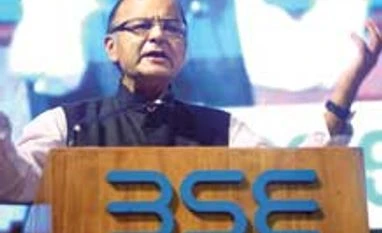
BS Reporter Mumbai Taking overhaul of the legal framework for the financial sector on priority, the government is set to introduce many changes to laws, regulations and administrative rules to implement the recommendations of the Financial Sector Legislative Reforms Commission (FSLRC). Even as a change in the process of reform continued, a large number of these recommendations would see implementation in the days to come, Finance Minister Arun Jaitley said in Mumbai on Saturday.
Jaitley was addressing a national seminar on the Indian Financial Code, organised by the Institute of Company Secretaries of India and BSE.
FSLRC, headed by retired Supreme Court judge, B N Srikrishna, had in March last year given a report on revamping the laws governing the financial sector. The committee was set up in March 2011 to rewrite financial laws and bring those in sync with the current requirements.
Besides preparing model Indian financial Code, with an emphasis on consumer protection, the committee had recommended formation of an appellate tribunal to hear appeals against orders of financial sector regulators.
The commission had also recommended a non-sectoral, principle-based, legislative architecture for the financial sector through restructuring and upgrade of existing regulatory agencies, and creating new agencies wherever needed for better governance and accountability.
In September this year, the National Democratic Alliance government at the Centre had formed task forces to work on the FSLRC recommendations. Jaitley said the four expert groups were currently examining the various aspects of the committee’s suggestions, as many changes to existing laws and regulations might be required.
The task forces would lay down the road map for upgrade of existing agencies and establishment of new agencies — the Financial Sector Appellate Tribunal, Resolution Corporation, Public Debt Management Agency and Financial Data Management Centre.
Jaitley said the system had now come to a stage where there was a need to try and find a balance — a government monopoly needed to be broken and the influence of markets in the case of aberrations had to be dealt with.
The FSLRC recommendations have come under a severe criticism from regulators like Reserve Bank of India (RBI), fearing a shrinkage of their jurisdictions. In June, RBI Governor Raghuram Rajan had opposed FSLRC’s proposal to merge regulators. The recommendation was not based on a deep analysis, Rajan had said.
FSLRC had emphasised synergies in bringing together some regulators as one entity. But in the process it had suggested breaking up other regulators. Such an action would lead to attendant loss of synergies, the RBI governor had pointed out.

 "Slew of changes to financial sector laws in offing: Jaitley")

