Statsguru: Rural India's distress conundrum

Leading economic indicators suggest a recovery is underway
(Click on picture for details)
Ishan Bakshi
Last Updated : Jul 17 2017 | 2:40 AM IST
It’s difficult to make sense of what’s happening in the rural economy. 

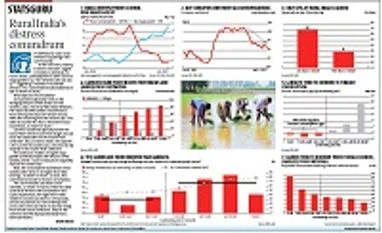
On the one hand, leading economic indicators suggest a recovery is underway. As Chart 1 shows, unemployment is down and real wage growth is up. Two-wheeler sales are also up — suggesting a recovery in household demand. Yet, rural sentiment has weakened of late as shown in Chart 2. 

What explains this dichotomy?

One possible explanation rests on the diverging fortunes of the landed and the landless, says a report by HSBC Global Research. The report classifies landless households as those owning less than one hectare of land, while the remaining form the landed class. The latter account for less than a third of the rural households, as shown in Chart 3. 

Landless households typically receive the bulk of their overall income from wages and are much less dependent on the income from cultivation. But, as Chart 4 shows, the opposite is the case for the landed class, who tend to rely majorly on the income from cultivation.

This distinction matters as higher wage growth positively impacts the fortunes of the landless, while a crash in food prices negatively impacts the landed class. 

Now, the consumption expenditure of the landless often tends to be higher than their earnings, as shown in Chart 5. As such, this class tends to borrow to finance consumption.

Yet it is the landed class that is more indebted, as shown in Chart 6. While this debt could be to finance both consumption and capital expenditure, the high level of debt relative to income puts them in a financially precarious position at a time of falling food prices. But as this class tends to borrow mostly from formal sources of finance, they are the ones who benefit disproportionately from a farm loan waiver.  

(Click on picture for details)


One subscription. Two world-class reads.

Already subscribed? Log in

Subscribe to read the full story →
*Subscribe to Business Standard digital and get complimentary access to The New York Times

Smart Quarterly

₹900

3 Months

₹300/Month

SAVE 25%

Smart Essential

₹2,700

1 Year

₹225/Month

SAVE 46%
*Complimentary New York Times access for the 2nd year will be given after 12 months

Super Saver

₹3,900

2 Years

₹162/Month

Subscribe

Renews automatically, cancel anytime

Here’s what’s included in our digital subscription plans

Exclusive premium stories online

  • Over 30 premium stories daily, handpicked by our editors

Complimentary Access to The New York Times

  • News, Games, Cooking, Audio, Wirecutter & The Athletic

Business Standard Epaper

  • Digital replica of our daily newspaper — with options to read, save, and share

Curated Newsletters

  • Insights on markets, finance, politics, tech, and more delivered to your inbox

Market Analysis & Investment Insights

  • In-depth market analysis & insights with access to The Smart Investor

Archives

  • Repository of articles and publications dating back to 1997

Ad-free Reading

  • Uninterrupted reading experience with no advertisements

Seamless Access Across All Devices

  • Access Business Standard across devices — mobile, tablet, or PC, via web or app

Next Story



