Stoke growth or go for fiscal prudence?
Jaitley gets contrasting advice from economists, who're also not so bothered about impact of the trade-offs
Indivjal Dhasmana New Delhi As Finance Minister Arun Jaitley prepares the Union Budget for 2014-15, he might either prefer to be guided by the Vijay Kelkar committee's road map on fiscal consolidation or choose advice from India-born economist Arvind Panagariya to concentrate on economic growth.
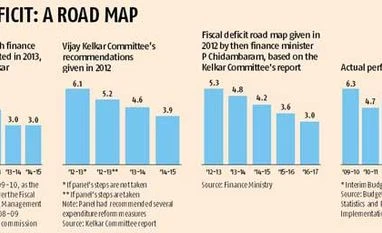
Panagariya, a professor at Columbia University, recently said the government should concentrate on growth, even if it meant the Centre's fiscal deficit would be 4.5 per cent of gross domestic product (GDP) for the current financial year, against the 4.1 per cent pegged in the interim Budget. Whereas, the Kelkar panel schedule, given in 2012, wanted the government to contain the deficit at 3.9 per cent of GDP for 2014-15.
On the basis of the Kelkar report, former finance minister P Chidambaram had given a new schedule on fiscal consolidation, by which the deficit should come down to 4.2 per cent of GDP in this financial year, against 4.8 per cent in 2013-14. In the interim Budget, he'd projected an improvement over his own road map and pegged the deficit at 4.1 per cent for the current financial year, as the deficit had come down to 4.5 per cent in 2013-14.
As such, Chidambaram had termed Panagariya's suggestion as mistaken, earlier this month. When asked, neither would talk further on the issue.
However, a member of the Kelkar panel does not find anything wrong in the fiscal deficit widening to 4.5 per cent of GDP for this financial year, though for reasons different from those given by Panagariya. The latter had said the government should not be unduly worried about a small fiscal slippage, and boost infrastructure spending. The Kelkar committee member told Business Standard it would be too much to expect the new government to stick to the 4.1 per cent target for 2014-15. "Much has changed since we presented the report in 2012 and now. The (previous) government did not do the kind of expenditure restructuring we'd wanted it to do," the member said.
C Rangarajan, former chairman of the earlier Prime Minister's Economic Advisory Council, did not agree on widening the target for FY15. "I think containing the fiscal deficit at 4.1 per cent of GDP will send the right signals. Nobody is saying it is not difficult to achieve 4.1 per cent but that is desirable," he said.
Rangarajan said nobody wants the government to immediately go for a fiscal deficit at three per cent of GDP, the ultimate target to be achieved by 2016-17. "In some sense, we have relaxed the mandate, as we did not say go for three per cent immediately." In any case, he recommended the deficit be set lower than in the previous year (4.5 per cent).
Panagariya, in fact, wants the government to raise capital expenditure from 1.76 per cent of GDP to two per cent. This would require slightly over Rs 30,000 crore of additional money.
Rangarajan, also chairman of the Madras School of Economics, said the fiscal deficit was not rising due to capital expenditure but because of rising revenue expenditure. "Allocations should be redistributed to capital expenditure. Clear decisions on subsidies are required," he said.
CARE Ratings' chief economist Madan Sabnavis said, "Ideally we should cut on some other expenditures, say fuel or fertiliser subsidy, and use the savings for additional capex." The option, he said, was to work on the present targeted expenditure for capex and not wait to see how the year evolved. The interim Budget had projected capex to grow about 12 per cent to Rs 2.13 lakh crore for FY15, against the Rs 1.9 lakh crore in the revised estimate for FY14. It was, however, less than the Rs 2.29 lakh crore estimated in the budget estimate for FY14. An alternative, Sabvnavis said, was to earmark an additional amount for capex, perhaps by 0.5 percentage points, Keynesian in spirit.

 "Stoke growth or go for fiscal prudence?")


 Connect with us on WhatsApp