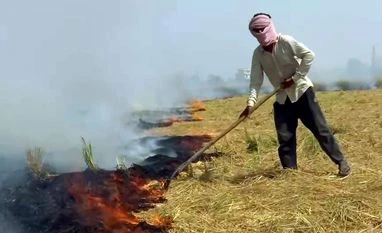
Though the impact of stubble burning seems to have been lessened owing to sudden showers in many parts of North India a few days back, the menace is likely to be back as the dry weather returns.
The latest data shows between September 15 and October 26, some 9,592 cases of stubble burning were detected in six states. Of these, 6,463 were in Punjab, 2,010 in Haryana, 720 in UP, 61 in Rajasthan, and 346 in Madhya Pradesh. There were no cases in Delhi. The number of incidents this year (September 15 to October 26) is 58.3 per cent lower than in 2020.
But from October 1 to 26, there has been a sharp rise in stubble burning sequentially.
Over the years, the Central and state governments have made efforts to control the problem and all of them have had mixed success. This possibly explains why farmers still burn paddy stubble despite fines and penalties.
Paddy stubble burning is practised mainly in the Indo-Gangetic plains of Punjab, Haryana, and UP to clear the fields for rabi crop sowing.
A scheme to promote in-situ management of crop residue in Punjab, Haryana, Uttar Pradesh and Delhi was implemented in 2018-19.
Under this scheme, financial assistance at 50 per cent of the cost of machinery is provided to farmers for purchasing crop residue management machinery. Financial assistance at the rate of 80 per cent of the project cost is provided to cooperative societies of farmers, farmers producers organisations (FPOs).
According to its reply in Parliament, the government said from 2018-19 to 2020-21, more than 30,900 custom hiring centres were established and more than 158,000 crop residue management machines were supplied to these centres and individual farmers of these four states.
However, several reports and voices from the ground indicate the success of the scheme has been limited, with several major states not forthcoming in spending the allocation and also farmers are reluctant to purchase the machines due to their high cost of running and their limited use.
According to some reports, since 2014-15, all states together have spent around 86 per cent of the funds, estimated to be around Rs 4,600 crore, released under the scheme.
The number of machines available is low in proportion to the stubble produced and hence not enough to cover the entire waste.
The renewable energy ministry has been promoting the utilisation of paddy stubble for producing biogas.
A few years back, India’s largest thermal power producer, NTPC, floated a tender to buy farm stubble at Rs 5,500 a tonne for its power plants.
At least 12 second-generation bioethanol plants have been planned by the government, which requires 150,000 tonnes of biomass — typically rice straw, wheat straw and bamboo shoots — for each of these plants annually.
Officials said some plants were on the fast track. They include HPCL’s planned unit in Bhatinda (Punjab), IOC’s Panipat (Haryana) and BPCL’s Bargadh (Odisha).
According to estimates by the government, there is potential for close to a hundred biogas plants in Punjab and Haryana.
Among the series of ventures lined up to use stubble for producing energy till a few years back only two in Punjab had materialised.
At the same time, NTPC had till some time back issued six tenders to procure biomass pellets but the supply has been limited, officials had said. They said while there were several agencies that supplied crop residue-based biomass pellets, the supply falls short.
Farmers, on the other hand, complain that turning stubble into pellets which can then be used by power plants and bio-gas generating units is not that easy, while sometimes the price offered is also not remunerative enough.
Decomposers are bio-enzymes that decompose the stubble and bury it in the field. This not only addresses the problem of burning but also nourishes the soil.
However, several farmers complain the time taken by decomposers to treat the stubble is unusually long, which eats into their short window between paddy harvest and next crop sowing.
But companies that are doing the trials believe the latest ones are far more efficient and effective in decomposing the stubble and can do so in under 25 days.

 "Stubble burning: Many measures but complete elimination off the mark")












 Connect with us on WhatsApp