Sustainable development: 2030 commitment seems too costly
Subhayan Chakraborty New Delhi This country will need at least Rs 546 lakh crore ($8.3 trillion) to fully meet the global Sustainable Development Goals (SDGs) by 2030, a report supported by the Union ministry of environment, forests and climate change has said.
SDGs are a set of socio-economic targets agreed upon by the United Nations that all countries should strive towards. Business Standard reviewed the report, which says by the first level of estimates, India will face a shortfall of Rs 35 lakh crore or $556 billion every year till 2030.
The report has the backing of the United Nations Development Programme and was published by think tanks Technology and Action for Rural Advancement and the Development Alternatives Group.
The SDGs are part of a larger framework, namely the Post 2015 Global Agenda for Sustainable Development. They consist of 17 goals and 169 linked targets - social, economic and ecological parameters. The ambitious agenda, set to be formally adopted next month, calls for significant rethinking in development processes across the world.
They are to replace the Millennium Development Goals (MDGs) established in 2000 at the Millennium Summit of the UN. According to a report published by the ministry of statistics and programme implementation in February this year, India had made favourable progress in achieving the eight mandated goal, along with their 12 targets and 35 indicators.
Critics of the MDGs complained of a lack of analysis and justification behind the chosen objectives, beside the difficulty or lack of measurement for some. The SDGs are touted as an improvement over those but do not come cheaply.
With the SDGs, this country faces major challenges in funding its priority sectors. These include food security, economic growth, skills and jobs, and water and sanitation. Even after taking into account existing government schemes, the estimated financial requirement is much higher than we can afford.
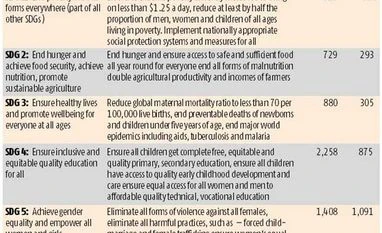
For instance, the report says India needs an extra Rs 18.5 lakh crore ($293 billion) to ensure complete food security and to eradicate hunger. This includes access and distribution costs of food, as well as for financing sustainable agricultural systems. It adds, "Climate change might influence the availability of various resources for agriculture, further increasing the costs."
To ensure inclusive education for all, an estimated total of Rs 142 lakh crore ($2,258 billion) is required. However, a gap of Rs 55 lakh crore ($875 billion) remains if this is to be implemented throughout the existing educational system, from school and higher education to skilling people through vocational courses. With an estimated two per cent of the existing workforce having formal skill training, whereas 90 per cent of jobs in India are skill-based, this is an uphill task. The central government has recently announced a target of skilling 500 million individuals by 2022.
For the goal of achieving gender equality and women empowerment, it notes the Gender Gap Index here is comparable with Bangladesh, Cambodia and Ghana. Comparing the per capita spending requirement of these countries to ensure gender equality, India requires Rs 89 lakh crore ($1,408 billions) by 2030. Current trends in gender budgets show a gap of Rs 69 lakh crore ($1,091 billion).
The report very clearly states, "Public finance alone would be inadequate and even private finance available might not be able to meet the gaps being estimated."
At the global level, total investment needs according to Unctad would be $5-7 trillion yearly. In developing countries, it is roughly $3.9 trillion a year, mainly for basic infrastructure - roads, power, food security, etc. Current global investment in these sectors is around $1.4 trillion. Funding for SDGs has been a prickly issue, with no consensus. The third International Conference on Financing for Development was recently held in July, in Addis Ababa, Ethiopia, the results of which have been disappointing. Developed countries did not make any additional commitments to provide money above and beyond the existing levels.

 "Sustainable development: 2030 commitment seems too costly")


 Connect with us on WhatsApp