These villages have no water beneath the ground, and no hope in sight

The concluding part of a three-part series looks at recharge efforts in a Haryana village even as some farmers in Rajasthan neither have water nor hope
water crisis
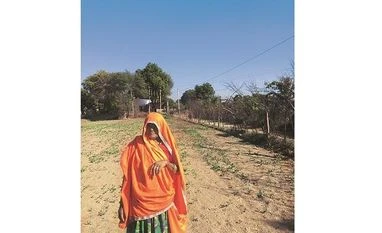
Prem Devi of Udaipuria village narrates how two borewells in her holding of less than 0.5 hectare stopped pumping water about six years earlier
Jyoti Mukul
4 min read Last Updated : Jan 01 2020 | 8:07 PM IST
Women coming out to talk is usually not the case in most parts of Rajasthan and Haryana. So, when Prem Devi of Udaipuria village in Chomu tehsil of Jaipur district starts to speak, she is not sure whether she should sit or stand while narrating her woes.  

Just outside her courtyard is a papaya tree, with plastic wrapped around its fruits that appear big but are yet to ripen. After being prodded to sit, she narrates how two borewells in her holding of less than 0.5 hectare stopped pumping water about six years earlier. Her family now depends on rain-fed irrigation to grow some bajra (local millets) for household consumption and fodder for goats. Her son works on construction projects as an artisan to eke a living.

Among her many complaints is grid electricity. The family used to get a subsidy of Rs 833 in the power bill itself but the rules have changed and there is cash transfer into the bank account. “The cash no more comes,” she says, as officials clarify that this could be due to non-linking of their bank account.

Kashi Ram of Bhaisawata Khurd wonders if this road work (pictured) could turn around his fate

About eight km from the National Highway 52, which connects Jaipur and Agra, Murli Dhar in Bharni village of Sri Madhopur tehsil of Sikar district has a similar challenge of dried farmland. His family of 12 survives on the earnings of his labourer-sons. All he can grow after the rainy season is bajra and taramira, an oilseed grown in drier regions of north-western India.


In fact, taramira is close to the mustard crop that is traditionally grown in Rajasthan and Haryana. Dharamveer Dudi, assistant director in the horticulture department, Jhunjhunu district, says as compared to wheat, a better crop for the region is mustard. “If wheat gives Rs 2,000 a quintal, mustard gives around Rs 4,000. Besides, wheat requires more fertiliser and at least six to seven watering cycles. Mustard requires only three and very little fertiliser,” he explains. Also, mustard foliage helps to produce micro organisms which are good for soil health.

Across Jhunjhunu district, right up to Haryana’s Mahendragarh, a number of khejri (prosopis cineraria) trees can be seen within the farms. These traditional ones fix nitrogen content in soil and are considered good for the area. “You will mainly see these trees in Rajasthan. Once you cross the border on to Haryana, they won’t be seen,” says Dudi.

The road that leads to Narnaul in Haryana is abuzz with six-laning of National Highway 11. Kashi Ram of village Bhaisawata Khurd is wondering if this road work could turn around his fate — his dry farmland is along the route and agriculture earns him no income. His family gets water for drinking from a village well; for irrigation, he banks on rainwater. Some years before, he had set up a small poultry unit but it did not last. “I let out the (poultry) shed for weddings now,” he says.


Since water scarcity knocks at the doors of most areas in Rajasthan and Haryana, the state governments have made micro irrigation practices mandatory with solar powered pump scheme. With power bills virtually nil for irrigation, there is always a danger of overexploitation of groundwater. 


V Saravana Kumar, director (horticulture) in the Rajasthan government, says the state will be promoting universal solar water pump controller to incentivise use of solar power for non-irrigation productive use like thrashing, atta chaki, etc. “It will be one connection for irrigation and three for other uses.” Besides, component C of the Centre’s KUSUM programme will enable farmers to sell the extra power to power distribution companies. This is intended to disincentivise over exploitation of ground water.

The Deroli Ahir village of Mahendragarh district in Haryana has presented another plausible scenario for areas that are close to some irrigation canals. “The dry land problem has been reversed partially,” says Bhoop Singh. The village panchayat gave about 1 hectare land to make a pond and to two recharge wells. Overflow from the nearby Narnaul irrigation canal is directed into this land, besides collecting rain water. “This has become a lifeline in the 5-km radius,” says Singh who is busy getting a new house ready next to his old house in preparation for his son’s wedding in the coming year. He is rather unconcerned that the shadow of the new structure is reducing the output of his solar panels next doors. 
Series concludes

One subscription. Two world-class reads.

Already subscribed? Log in

Subscribe to read the full story →
*Subscribe to Business Standard digital and get complimentary access to The New York Times

Smart Quarterly

₹900

3 Months

₹300/Month

SAVE 25%

Smart Essential

₹2,700

1 Year

₹225/Month

SAVE 46%
*Complimentary New York Times access for the 2nd year will be given after 12 months

Super Saver

₹3,900

2 Years

₹162/Month

Subscribe

Renews automatically, cancel anytime

Here’s what’s included in our digital subscription plans

Exclusive premium stories online

  • Over 30 premium stories daily, handpicked by our editors

Complimentary Access to The New York Times

  • News, Games, Cooking, Audio, Wirecutter & The Athletic

Business Standard Epaper

  • Digital replica of our daily newspaper — with options to read, save, and share

Curated Newsletters

  • Insights on markets, finance, politics, tech, and more delivered to your inbox

Market Analysis & Investment Insights

  • In-depth market analysis & insights with access to The Smart Investor

Archives

  • Repository of articles and publications dating back to 1997

Ad-free Reading

  • Uninterrupted reading experience with no advertisements

Seamless Access Across All Devices

  • Access Business Standard across devices — mobile, tablet, or PC, via web or app

Topics :Water crisisfarm crisis

Next Story


