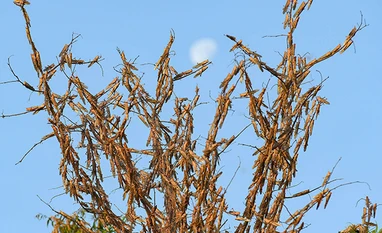
Chairing a high level meeting at his official residence in Lucknow, Adityanath said while measures were needed to prevent crop damage by locusts, it was important to ensure that panic was not created among people.
A total of 15 districts, including the Bundelkhand region, are more prone to the locust attack viz. Jhansi, Lalitpur, Agra, Mathura, Shamli, Muzaffarnagar, Baghpat, Hamirpur, Mahoba, Banda, Jalaun, Chitrakoot, Etawah and Kanpur Dehat.
While locusts have entered the state from the neighbouring areas of Rajasthan and Madhya Pradesh, so far there have been no reports of any significant damage to agricultural crops in UP.
Typically, locusts attack in swarms of millions, eating green leaves of all the plants quickly and in humongous quantities. They breed and grow in winter, from November to December, in spring, from January to June and in summer, from July to October.
Recently, the chief minister had instructed the district magistrates and respective agricultural department officials to take appropriate steps to avert the locust attack. They were asked to avail of funds for the purpose under the Disaster Management Act 2005.
Meanwhile, a control room has been set up at the state level to co-ordinate the steps being taken across the affected districts to curb the raging locust menace. The control room, with the help of its field personnel, will keep track of the movement of locust swarms in these border areas and issue timely advisories to district level officials to thwart locust attacks.
Moreover, a nodal officer, a taskforce and a control room have been instituted at the respective district levels. A detailed advisory, including guidelines and information about the locusts, has been provided to the respective district officials to help them take timely action.
The local residents and farmers have been enlightened on the subject, while the village level committees and bodies have been mobilised to make a coordinated effort against the threat.
The advisory includes making high pitch sounds and noise with the beating of drums, tin canisters, thalis etc by groups of people to disperse and scare away locusts.
In February 2020, the state sugarcane department had issued a similar advisory to farmers, when locust wreaked havoc in neighbouring Pakistan and caused concern in the western Indian states of Gujarat and Rajasthan.
At that time, the state farmers were advised to spray the sugarcane crop with insecticides, such as chlorpyrifos, chlorpyrifos bundiomethrin, fipronil and lambda if locusts were seen in their fields.
One subscription. Two world-class reads.
Already subscribed? Log in
Subscribe to read the full story →
Smart Quarterly
₹900
3 Months
₹300/Month
Smart Essential
₹2,700
1 Year
₹225/Month
Super Saver
₹3,900
2 Years
₹162/Month
Renews automatically, cancel anytime
Here’s what’s included in our digital subscription plans
Exclusive premium stories online
Over 30 premium stories daily, handpicked by our editors


Complimentary Access to The New York Times
News, Games, Cooking, Audio, Wirecutter & The Athletic
Business Standard Epaper
Digital replica of our daily newspaper — with options to read, save, and share


Curated Newsletters
Insights on markets, finance, politics, tech, and more delivered to your inbox
Market Analysis & Investment Insights
In-depth market analysis & insights with access to The Smart Investor


Archives
Repository of articles and publications dating back to 1997
Ad-free Reading
Uninterrupted reading experience with no advertisements


Seamless Access Across All Devices
Access Business Standard across devices — mobile, tablet, or PC, via web or app
)