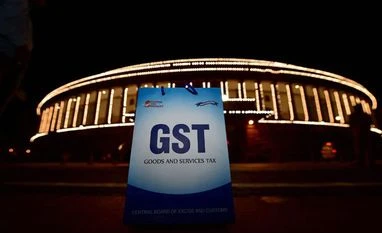
The Goods and Services Tax (GST), India's biggest tax reform since Independence, was on Friday launched at midnight by President Pranab Mukherjee and Prime Minister Narendra Modi at Parliament's historic Central Hall. With the stroke of the gong, the current tax rates were replaced by GST rates. GST, which replaces a slew of indirect taxes with a unified one, is set to dramatically reshape the country's $2-trillion economy.
Here is a snapshot of some of the important things you need to know about the new tax regime:
The Goods and Services Tax (GST) is a uniform indirect tax levied on goods and services across the country. GST, as an umbrella tax, will replace central taxes like central excise, service tax, additional duties of excise & customs, special additional duty of customs, besides cesses and surcharges, on supply of goods and services.
• GST envisages all transactions and processes to be done only through the electronic mode, to achieve a non-intrusive administration. This will minimise the taxpayer's physical interaction with tax officials.
• GST provides for the facility of auto-populated monthly returns and annual return.
• It also facilitates the taxpayers by prescribing grant of refund within 60 days, and provisional release of 90 per cent refund to exporters within 7 days.
• Further facilitation measures include interest payment if refund is not sanctioned in time, and refund to be directly credited to bank accounts.
• Comprehensive transitional provisions for ensuring smooth transition of existing taxpayers to GST regime, credit for available stocks, etc.
• Other provisions include system of GST Compliance Rating, etc.
• Anti-profiteering provisions for protection of consumer rights.
• Under the GST regime, exports will be zero-rated in entirety, unlike the present system where refund of some of the taxes does not take place due to fragmented nature of indirect taxes between the Centre and the States.
• GST is largely technology driven and will reduce the human interface to a great extent
• GST is expected to improve ease of doing business in India.

 "What is GST? Your 10-point guide to independent India's biggest tax reform")











