Why Big Oil won't reduce India's import dependence

The bulk of the foreign investment is in refineries and retailing, not in discovery and production
graph
graph
Jyoti Mukul New Delhi
Last Updated : Oct 18 2017 | 10:47 PM IST
In his latest visit to India earlier this month, Amin H Nasser, president and chief executive officer, Saudi Aramco, quoted International Energy Agency data to say India is likely to be among the world’s fastest-growing oil markets, with demand almost doubling to about 10 million barrels a day by 2040. 

Before this, Nasser was part of an industry meeting with Prime Minister Narendra Modi. A day earlier, Saudi Aramco, the world’s largest crude oil producer, inaugurated its India office, and Nasser’s statement was an acknowledgement of the fact that, just like other commodities and services, a growing economy made India an attractive market for petroleum producers, too.

Apart from Saudi Aramco, top CEOs and officials from Rosneft, BP, Reliance, Exxon Mobil, Royal Dutch Shell, Vedanta, Schlumberger, Halliburton and several domestic companies were also present at the prime minister’s meeting. 

Afterwards, Union Petroleum Minister Dharmendra Pradhan said India offers a $300-billion investment opportunity over the next 10 years across the petroleum value chain. The moot question is: Would these investments achieve the government’s aim to reduce India’s dependence on oil and gas imports by 10 per cent by 2022, and 50 per cent by 2030? 

Like Saudi Aramco, other global majors primarily plan to invest in India’s downstream sector — refining, petrochemicals, retailing and lubricants — and midstream infrastructure like pipeline building. Exxon Mobil and Shell are already present in India’s lubricants business. Part of the new investment will cater to domestic demand, but much of it will also feed the international market. But critically, expanding downstream capacity creation through foreign investments will create a concomitant increase in crude oil demand too. 

Petroleum products are among India’s biggest export items. In the five months to August 2017, India exported 27 million tonne of petroleum products against imports of 16 million tonne. It is also becoming a major oil consumer. India’s crude oil consumption grew 8.3 per cent to 212.7 million tonne in 2016, compared with global growth of 1.5 per cent, making it the world’s third-largest oil consuming nation. According to the International Energy Agency, this demand will increase to 580 million tonne annually by 2040.

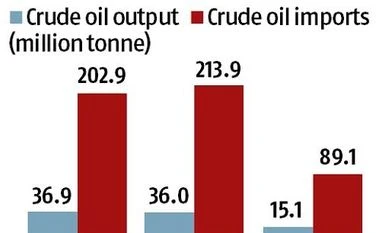
Clearly, a large part of this expected demand surge will come from the export market since data put out by the Petroleum Policy Analysis Cell shows a 5 per cent increase in domestic product demand in 2016-2017 over the previous year. India’s domestic crude oil production fell to 36 million tonne in 2016-17, from 36.9 million tonne the year earlier.

The last time a major global player came into India’s upstream business was 2011, when British Petroleum joined in as a 30 per cent partner in Reliance Industries’ oil and gas blocks in India. Europe’s third-biggest oil company, however, made its intentions of entering the downstream sector clear when it secured government approval to set up 3,500 retail outlets in India last year. This makes it the tenth company planning to be in this space. 

Decontrol of petrol and diesel prices has made this segment attractive, though with around 90 per cent share, state-owned Indian Oil Corporation, Bharat Petroleum Corporation and Hindustan Petroleum Corporation dominate this market. BP had earlier obtained approval to retail aviation turbine fuel in India as well. 

R S Butola, former chairman, Indian Oil Corporation, however, does not see fresh investment even in refineries, though the government has offered Saudi Aramco a stake in the planned 60-million-tonne West Coast refinery of state-owned oil majors. The Saudi producer is more likely to invest in the $4.6-billion petrochemical business of ONGC Petro Additions Ltd (OPal), which was earlier in talks with Kuwait Petroleum Corporation for a similar partnership that did not make much headway. The investment in OPaL will allow Aramco to tap the Indian market, and the ONGC subsidiary will be able to use Saudi Aramco’s export channels to  international markets. 

Besides, Rosneft, which took over Essar Oil in August for $1.9 billion, acquired an existing 20-million-tonne refinery in Vadinar (Gujarat), 3,500 retail outlets and associated refinery infrastructure, a 58-million-tonne capacity port and a 1010-Mw power plant. These investments came in assets that had already been created by the Ruia-led Essar Oil. Though Rosneft has indicated it wants to invest more, it is still not clear where these new investments will come in. Clearly, however, both Saudi Armaco and Rosneft, competitors in the global arena, would like to secure India as a market for future crude oil supply.  

Butola says global petroleum companies may use India as a trading centre. “While they may want to do trading, they face infrastructure constraints so they may want to invest in creating that ecosystem,” he says.

It is not that India is not offering opportunities in the upstream sector. It has come up with one round of auctions for small and marginal fields and has replaced the New Licensing and Exploration Policy with the Hydrocarbon Exploration and Licensing Policy which offers better terms for contracts. Under HELP, the open acreage policy — allowing companies to carve out the exploration area and then make the government an offer — has also been launched. 

Production enhancement contracts for fields held by Oil and Natural Gas Corporation and Oil India will open up investment avenues as well, even though India’s geological attractiveness, or oil-yielding potential, remains low. 

The Union government may be offering better terms but, as Butola points out, sanctity of contracts remains an issue. “Companies are not sure if terms will remain the same midway into the contracts,” he says. Retrospective taxation on  buyouts of Indian assets and the government’s insistence that Cairn India (now Vedanta Ltd) withdraw international arbitration to get approval of its buy-out by Anil Agarwal-led Vedanta group serve to deter long-term investors.

Besides, other countries offer better terms of business. In the UK, for instance, the government last year cut tax in the difficult North Sea area and has set up a committee to lower decommissioning costs to enable the sale and purchase of oil assets. Latin American and a host of African countries offer larger acreages on better terms.

All this suggests that the rush of foreign investment in oil and gas is unlikely to reduce India’s import dependence. The prospect of that is contingent on large-scale discoveries and their careful and closely monitored development so that the anti-climactic experience of the KG-D6 discovery, with its flagging production, is not repeated. 


FDI in oil and gas
  • LN Mittal group: Formed a joint venture with HPCL in Guru Gobind Singh Refinery at Bhatinda
     
  • British Petroleum: Owns 30 per cent stake in RIL’s domestic oil and gas blocks
     
  • Shell: Owns an LNG terminal at Hazira, Gujarat; has a chain of retail outlets
     
  • Rosneft: Bought Essar Oil along with Trafigura-UCP consortium
     
  • Exxon Mobil: Has India subsidiary that distributes, sells and markets Mobil-branded lubricants and specialties

One subscription. Two world-class reads.

Already subscribed? Log in

Subscribe to read the full story →
*Subscribe to Business Standard digital and get complimentary access to The New York Times

Smart Quarterly

₹900

3 Months

₹300/Month

SAVE 25%

Smart Essential

₹2,700

1 Year

₹225/Month

SAVE 46%
*Complimentary New York Times access for the 2nd year will be given after 12 months

Super Saver

₹3,900

2 Years

₹162/Month

Subscribe

Renews automatically, cancel anytime

Here’s what’s included in our digital subscription plans

Exclusive premium stories online

  • Over 30 premium stories daily, handpicked by our editors

Complimentary Access to The New York Times

  • News, Games, Cooking, Audio, Wirecutter & The Athletic

Business Standard Epaper

  • Digital replica of our daily newspaper — with options to read, save, and share

Curated Newsletters

  • Insights on markets, finance, politics, tech, and more delivered to your inbox

Market Analysis & Investment Insights

  • In-depth market analysis & insights with access to The Smart Investor

Archives

  • Repository of articles and publications dating back to 1997

Ad-free Reading

  • Uninterrupted reading experience with no advertisements

Seamless Access Across All Devices

  • Access Business Standard across devices — mobile, tablet, or PC, via web or app

Next Story



