Workforce to consumption: India, China's economies explained in 6 charts

China's working-age population is receding, as the share of persons aged between 15 and 64 has started falling in recent years
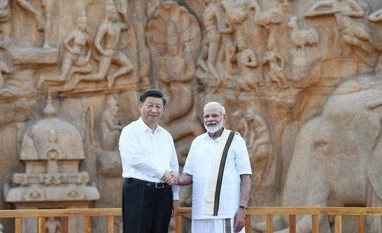
Chinese President Xi Jinping, Mamallapuram, Prime Minister Narendra Modi, Informal summit
Abhishek Waghmare
2 min read Last Updated : Oct 14 2019 | 12:04 AM IST
Chinese President Xi Jinping just concluded his informal visit to India, meeting Prime Minister Narendra Modi in Mamallapuram. Both leaders discussed various issues, ranging from economic cooperation in global stability and security. Interestingly, China is currently at an important juncture with changing demographics and economic landscape.

China's working-age population is receding, as the share of persons aged between 15 and 64 has started falling in recent years. The same is rising in India (Chart 1). Similarly, the absolute strength of the Chinese labour force dropped for the first time since the demographic bulge about three decades ago. India's labour force, on the other hand, is growing (Chart 2).

Savings and investment rates are also declining in China (Chart 3). A decline is being witnessed in India as well,which needs to be reversed.
 
For the first time since the 1990s, China is on the path to record a current account deficit, with surplus shrinking to 0.4 per cent of gross domestic product in 2018 (Chart 4). The surplus on current account was as high as 10 per cent of GDP a decade ago. 

This is also because of China’s shift from investment to consumption-led growth. The share of consumption in China's GDP is rising steadily since 2010, with a marginal blip in 2018 (Chart 5). 

But how will India benefit from this? 

A recent Credit Suisse report puts the value of exports shifting from China at nearly $450 billion. But it estimates that Vietnam, not India, would benefit the most from the shift (Chart 6). India would benefit with exports worth $70 billion, adding to its $330 billion worth of merchandise exports. 

StatsGuru is a weekly feature. Every Monday, Business Standard guides you through the numbers you need to know to make sense of the headlines; Sources: World Bank, Credit Suisse; Compiled by BS Research Bureau


One subscription. Two world-class reads.

Already subscribed? Log in

Subscribe to read the full story →
*Subscribe to Business Standard digital and get complimentary access to The New York Times

Smart Quarterly

₹900

3 Months

₹300/Month

SAVE 25%

Smart Essential

₹2,700

1 Year

₹225/Month

SAVE 46%
*Complimentary New York Times access for the 2nd year will be given after 12 months

Super Saver

₹3,900

2 Years

₹162/Month

Subscribe

Renews automatically, cancel anytime

Here’s what’s included in our digital subscription plans

Exclusive premium stories online

  • Over 30 premium stories daily, handpicked by our editors

Complimentary Access to The New York Times

  • News, Games, Cooking, Audio, Wirecutter & The Athletic

Business Standard Epaper

  • Digital replica of our daily newspaper — with options to read, save, and share

Curated Newsletters

  • Insights on markets, finance, politics, tech, and more delivered to your inbox

Market Analysis & Investment Insights

  • In-depth market analysis & insights with access to The Smart Investor

Archives

  • Repository of articles and publications dating back to 1997

Ad-free Reading

  • Uninterrupted reading experience with no advertisements

Seamless Access Across All Devices

  • Access Business Standard across devices — mobile, tablet, or PC, via web or app

Topics :India china trade

Next Story



