Oscars 2019 deviated from the script, but signified a step forward, too

2019 Oscars' evening was dominated by people of colour and women - something that hasn't happened before
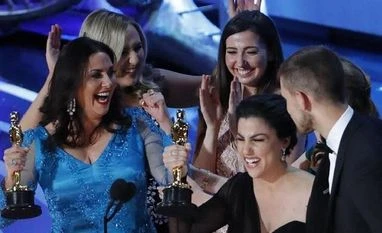
Oscars 2019, BEST DOCUMENTARY SHORT SUBJECT: PERIOD, END OF SENTENCE
Tanul Thakur | The Wire
Last Updated : Feb 26 2019 | 9:02 AM IST
The Academy Awards are known for following a script – in terms of not just the ceremony’s narrative but quite often the winners themselves. Like most awards, the Oscars are preceded by speculations and calculated predictions, and the final results, with few exceptions, are hardly surprising. This year’s Oscars, though, deviated from the script in multiple ways.

The obvious difference was the absence of host. The Academy, presumably mindful of the goof-ups in the last host-less Oscars, didn’t try anything flashy. The ceremony was straightforward, quiet and, there’s no kinder way to put it, dull. But given the messy lead-up to the awards, the Academy would have settled for that bargain.

The second deviation, however, was more significant: Roma, directed by Alfonso Cuarón, was nominated for 10 Oscars. In a mediocre year for Hollywood cinema, Roma, a Mexican Netflix film, looked to sweep the awards. But by the end of the night, it won just three Oscars (Best Director, Best Cinematographer, Best Foreign Language Film). It couldn’t even win the Best Picture, which went to Green Book – a safe, simple film which, in a stronger year, would have struggled to get nominated.

The Best Picture’s winners have not always been unanimous picks – Slumdog Millionaire (2008), The King’s Speech (2010) and Argo (2012), in recent years, have given the Oscars skeptics much to talk about – but none of them have been as shocking as Crash getting the nod over Brokeback Mountain, in 2005. The Green Book win comes close.


But this year’s Oscars also signify a step forward. Ruth E. Carter became the first African-American woman to win an Academy Award for Best Costume Design. Hannah Beachler won for Best Production Design, the first time a woman of colour has been nominated in the category. These wins become more poignant in terms of historical context: No African-American woman has won a non-acting Oscar in 30 years. Similarly, Rami Malek, playing Freddie Mercury in Bohemian Rhapsody, became the first Arab-American to win the Best Actor.

The Best Animated Film, Spider-Man: Into the Spider-Verse, like the multiple Oscar-nominated Black Panther, departing from tradition, centres on a superhero of African descent: the former’s protagonist is Afro-latino, the latter African-American. Spider-Man’s filmmaker, Peter Ramsey, became the first black director to win in an animated feature category.

The evening was dominated by people of colour and women – something that hasn’t happened before, a particularly potent fact in the wake of the 2015 #OscarsSoWhite protests. This year’s awards even had an Indian connection: Period. End of Sentence – set in an Indian village, tackling the stigma around menstruation – won the Best Documentary Short Subject. Guneet Monga, an Indian executive producer on the movie, was mentioned by filmmaker Rayka Zehtabchi in her acceptance speech.


But the ceremony, on its own, lacked personality. It opened to a middling performance by the Queen (the centrepiece of Bohemian Rhapsody), and then segued into a largely insipid evening. The ceremony’s highlights were so few that you could count them on your right-hand, with a few fingers remaining. Bradley Cooper and Lady Gaga, performing ‘Shallow’ from A Star is Born (which also won the Best Original Song), looked wonderfully co-ordinated – eyes locking, smiles dropping, singing in unison – that their piece seemed a whole in itself.

Then there was Olivia Colman, winning the Best Actress for The Favourite, a well-deserved honour for a searing, haunting performance, who gave a funny acceptance speech, which was also delightfully disorienting: thanking a list of people she feared she would forget, taking digs at the Oscars (and herself), acknowledging the other nominees (Glenn Close and Lady Gaga), in part-disbelief and -admiration.

The star of the evening though, by quite a distance, was Spike Lee, nominated for the Best Director and Adapted Screenplay. After a point, Lee was everywhere. He was visibly non-impressed – effecting a slight wink and a mordant nod – when John Mulaney and Awkwafina flattered him on stage before presenting the Best Animated Short Film award. Then Lee won for Best Adapted Screenplay, and he came on stage, jumped, and embraced Samuel Jackson, with the excitement of an animated teen. (“Do not turn that…clock on!” he said, in his thank you note, referring to the acceptance speeches’ time limit.) Not long after, Lee stood up, threw his hand in the air, and bowed when Barbra Streisand, presenting the best-picture clip for BlackKklansman, remarked on their shared Brooklyn roots.


When Green Book won the Best Picture, Lee reportedly waved his arms in anger before attempting to storm out of the theatre (but was stopped at the doors). He was asked about Green Book’s win backstage, and Lee, sipping champagne, had no patience for ambiguity: “I’m snakebit. Every time someone’s driving somebody, I lose,” he said, referring to Driving Miss Daisy – based on a premise similar to Green Room – overshadowing his breakout film, Do the Right Thing, at the 63rd Academy Awards.

Green Book has, in fact, been criticised for perpetuating the ‘White Saviour’ trope. Expecting giant strides from the Academy is perhaps naive, but this year’s Oscars exemplify that self-reflection is not beyond its realm.
Published in arrangement with The Wire

One subscription. Two world-class reads.

Already subscribed? Log in

Subscribe to read the full story →
*Subscribe to Business Standard digital and get complimentary access to The New York Times

Smart Quarterly

₹900

3 Months

₹300/Month

SAVE 25%

Smart Essential

₹2,700

1 Year

₹225/Month

SAVE 46%
*Complimentary New York Times access for the 2nd year will be given after 12 months

Super Saver

₹3,900

2 Years

₹162/Month

Subscribe

Renews automatically, cancel anytime

Here’s what’s included in our digital subscription plans

Exclusive premium stories online

  • Over 30 premium stories daily, handpicked by our editors

Complimentary Access to The New York Times

  • News, Games, Cooking, Audio, Wirecutter & The Athletic

Business Standard Epaper

  • Digital replica of our daily newspaper — with options to read, save, and share

Curated Newsletters

  • Insights on markets, finance, politics, tech, and more delivered to your inbox

Market Analysis & Investment Insights

  • In-depth market analysis & insights with access to The Smart Investor

Archives

  • Repository of articles and publications dating back to 1997

Ad-free Reading

  • Uninterrupted reading experience with no advertisements

Seamless Access Across All Devices

  • Access Business Standard across devices — mobile, tablet, or PC, via web or app

Next Story



