In an age of rage, Rishi Kapoor was Hindi cinema's enduring safety valve

Saibal Chatterjee on the endearing actor who lit up the screen
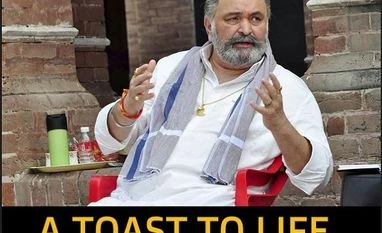
Rishi Kapoor
Rishi Kapoor on location at Nabha Haveli in Patiala in 2018
Saibal Chatterjee
6 min read Last Updated : May 02 2020 | 12:13 AM IST
Mera Naam Joker released in 1970. In Raj Kapoor’s magnum opus, a podgy Rishi Kapoor played a boy infatuated with a schoolteacher. The performance fetched him a National Award. His 50th year in the profession, 2020, began with a pandemic. But the timeless actor continued to be in demand.

He was diagnosed with cancer in 2018 and spent many months in a US hospital. But no sooner was he back in Mumbai than a major movie project — a Hindi remake of the Robert De Niro-Anne Hathaway starrer The Intern featuring him opposite Deepika Padukone — was announced. Rishi Kapoor died with his boots on, as it were.

What was it that made the endearing movie star so enduring? Thanks to his cherubic face, he was Hindi cinema’s first bona fide “chocolate boy”. But that term isn’t meant to be pejorative nor to indicate that Kapoor’s appeal was limited. He was a crowd-puller and yet no slave to expectations.  

On screen, Kapoor instinctively projected a “modern” persona — he was uber-sexual well before the term was coined. He did not exude either vain virility or aggressive masculinity. He spearheaded films about young, independent-spirited people straining to break the shackles of orthodoxy in a nation that, at that point, had been free for only 25-odd years.

When fresh thinking swept over popular Hindi films in the 1990s, a new wave of male stars arrived on the scene to push out the old, and designer cinema replaced the rough-hewn romances of yore, Kapoor was never out of sync. He carried on in the manner of one who had no baggage to account for.

Rishi Kapoor and Neetu Singh in a still from Khel Khel Mein (1975)

 
Kapoor travelled light. He moved into any nook and cranny that had space for him. He thrived. The transition allowed him in the new millennium to play a vicious human trafficker (Agneepath, 2012), a puckish nonagenarian grandfather (Kapoor & Sons, 2016), a middle-class Delhi teacher desperate to buy a car (Do Dooni Chaar, 2010) and an ageing Muslim lawyer fighting to defend his family’s fair name (Mulk, 2018) without missing a trick.

Kapoor’s career as a lead actor began (with Bobby, 1973) at the height of Rajesh Khanna’s reign and in the same year that Amitabh Bachchan’s Zanjeer hit the screen. He never let the labels pinned on him or the course of Khanna and Bachchan’s careers hustle him into a corner.

From the 1970s through the 1990s, Kapoor held his ground and appeared in all manner of solo-hero and multi-starrer films. He had more flops than hits, but the fate of a film never ever affected his standing. In an era defined by vengeful anger, he was Hindi cinema’s safety valve, a star who sang and danced while most others hollered and hectored on the big screen.

A gentle spirit, he sang of love, of youthful assertion, of rebellion against ensconced shibboleths. He won over a whole generation of Hindi film fans. While he exhorted them to give full rein to their “cuddle hormones” with songs like “Pyaar kar liya toh kya pyaar hai khataah nahin” (Kabhie Kabhie), he also warned them of the pitfalls of love through “Mere umar ke naujawanon, dil na lagana o deewano” (Karz). He did both with conviction and flair.

The stability of Kapoor’s career had nothing to do with the storied showbiz family he belonged to. His unwavering talent to liven up even pedestrian films kept him in the game. His lover-boy image was a malleable cloak that he either shed completely or tweaked ever so slightly whenever, and wherever, he needed to.

His spontaneity — in this respect, Kapoor had something in common with Irrfan Khan, who passed away a day ahead of him, although the two stars belonged to opposite ends of the entertainment industry spectrum and only did one film together (D-Day, 2013) — stood him in good stead.

While Bachchan was riding the crest of a wave, and alternative Hindi cinema — both parallel and middle-of-the-road — was emerging and finding takers, Kapoor, alongside and in the immediate aftermath of Sholay and Deewaar, delivered Khel Khel Mein, Rafoo Chakkar and Zinda Dil, all three in 1975, followed by Kabhie Kabhie, Hum Kisise Kum Naheen, Amar Akbar Anthony (a Bachchan vehicle in which Kapoor held his own), Laila Majnu, Doosra Aadmi, Sargam and Karz.

In Rafoo Chakkar, loosely inspired by Billy Wilder’s Some Like It Hot, Kapoor cross-dressed, sang in Asha Bhosle’s voice and teamed up with comedian Paintal, who, too, posed as a young woman and attracted the amorous attention of a man. Rafoo Chakkar, if only in jest, touched upon same-sex love and non-binary gender identity. Radical as hell, but few noticed.

Later in his career, in Karan Johar’s Student of the Year, Kapoor was an effusive, gay high school principal who nurses a secret yearning for the school’s straight and married sports coach. The actor was always game for risks but did not get due credit.
     
Kapoor was a youth icon because the lover he played feared nothing and gave full-throated vent to his feelings. In Khel Khel Mein, in the company of screen (and later real-life) soulmate Neetu Singh, he belted out “Khullam khulla pyar karenge hum dono / Iss duniye se nahin darenge hum dono”. Rajesh Khanna-style love ditties had waned and Bachchan, in the first flush of his rage-driven films, wasn’t given to breaking into song and dance. In an age of mounting disgruntlement, Kapoor’s was a voice at peace with itself.

He combined the urbane charm of Shashi Kapoor and the elemental “Junglee” spirit of Shammi Kapoor to help Hindi cinema romance leapfrog out of its old habits and acquire a style that contained intimations of the future.

His adaptability, rooted in an instinctive approach to his craft, enabled him to stay relevant as a romantic hero well into the 1990s. There was nothing in Saagar, Chandni, Henna and Prem Rog that suggested that he would ever have to worry about being trapped in the Khel Khel Mein mode.

Flexibility and off-the-wall joie de vivre remained Rishi Kapoor’s strong suits till the very end. In life and in films. 

One subscription. Two world-class reads.

Already subscribed? Log in

Subscribe to read the full story →
*Subscribe to Business Standard digital and get complimentary access to The New York Times

Smart Quarterly

₹900

3 Months

₹300/Month

SAVE 25%

Smart Essential

₹2,700

1 Year

₹225/Month

SAVE 46%
*Complimentary New York Times access for the 2nd year will be given after 12 months

Super Saver

₹3,900

2 Years

₹162/Month

Subscribe

Renews automatically, cancel anytime

Here’s what’s included in our digital subscription plans

Exclusive premium stories online

  • Over 30 premium stories daily, handpicked by our editors

Complimentary Access to The New York Times

  • News, Games, Cooking, Audio, Wirecutter & The Athletic

Business Standard Epaper

  • Digital replica of our daily newspaper — with options to read, save, and share

Curated Newsletters

  • Insights on markets, finance, politics, tech, and more delivered to your inbox

Market Analysis & Investment Insights

  • In-depth market analysis & insights with access to The Smart Investor

Archives

  • Repository of articles and publications dating back to 1997

Ad-free Reading

  • Uninterrupted reading experience with no advertisements

Seamless Access Across All Devices

  • Access Business Standard across devices — mobile, tablet, or PC, via web or app

Topics :Rishi KapoorRanbir KapoorIrrfan KhanBollywood

Next Story


