Sweeping changes in comex ownership
Banks, financial institutions, exchanges or depositories could hold up to 15% stake in a commodity exchange
BS Reporter Mumbai In what will institutionalise the ownership of commodity exchanges, the Forward Markets Commission (FMC) on Tuesday announced sweeping changes in the guidelines in this regard. It said banks, financial institutions, exchanges or depositories could hold up to 15 per cent stake in a commodity exchange. The new norms, which come into force with immediate effect, also mandate these exchanges to maintain net worth of Rs 100 crore on a continuous basis.
The concept of anchor investor been done away with and restrictions on members/brokers who aren’t able to trade have also been removed. Any shareholder of the exchange can also trade on the same exchange but in that case, he cannot hold a board seat on that exchange.
The new norms, resembling those in the securities market, mandate withdrawing the voting rights of an entity declared unfit to run an exchange; FMC also asked exchanges to freeze their voting rights and divest the stake of such entities.
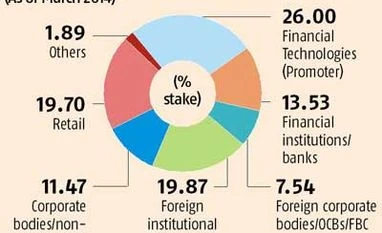
The new norms will have a bearing on Financial Technologies India Ltd (FTIL)’s stake sale in Multi Commodity Exchange (MCX). An FTIL spokesperson said, “The legality of issuing guidelines under the FC(R) Act is already before the Bombay High Court and despite that, FMC has issued another set of norms which are exceeding provisions of the FC(R) Act 1952 and are, hence ultra vires. We are affected more directly as our original entry conditions are being changed mid-course, to further compel us to exit our shareholding under policy distress. The timing, content and haste in the announcement of the revised norms leave doubts over their purpose.”
Also, several exchanges have to start enhancing their net worth and align with the new ownership norms, which could lead to many deals in the commodity exchange space. Except MCX and National Commodity & Derivatives Exchange (NCDEX), most exchanges have seen erosion of net worth; these will have to be boosted.
FMC has given 45 days to all exchanges to accommodate the revised ownership and net worth norms in their memoranda and articles of association and report that to the commission by June 23.
Exchanges that do not have net worth of at least Rs 100 crore have been given three years to adhere to this; till then, these exchanges cannot distribute profits to shareholders.
FMC also said 51 per cent of the paid-up equity of an exchange should be owned by the public. For foreign investors, the limit has been set at 49 per cent. Of this, up to 26 per cent is for foreign direct investment, while 23 per cent is for foreign institutional investors. Fungibility between the two segments isn’t allowed.
The cap for domestic investors has been kept at five per cent, though stock and commodity exchanges, depositories, banks, insurance companies and public financial institutions can hold up to 15 per cent. This will pave the way for the National Stock Exchange increasing its holding in NCDEX from 10 per cent to 15 per cent.
Several public sector units and public financial institutions hold up to 26 per cent stake in commodity exchanges. These entities have been given five years to adhere to the new norms. Institutions that have been allowed to hold 15 per cent equity in commexes are those regulated by financial regulators while PSUs are not regulated and, hence, can hold up to five per cent.
For all types of foreign investors, the investment limit has been fixed up to five per cent. Clearing corporations have been barred from holding rights and stakes in commodity exchanges. Also, board seats of these exchanges cannot be held by trading/clearing members and foreign investors. Earlier, a shareholder of the exchange wasn’t allowed to trade on the exchange in which the entity held equity. The new guidelines have no such restrictions, in line with norms in the securities market.
Soon after FMC announced these guidelines, the FTIL stock soared, hitting the five per cent upper circuit to close at Rs 299.95 on the BSE. The MCX stock rose 3.34 per cent to close at Rs 543.75 on hopes the FTIL stake sale would gain momentum.

 "Sweeping changes in comex ownership")


 Connect with us on WhatsApp