Mutual fund (MF) schemes whose returns go up when interest rates fall are back in focus with the Reserve Bank of India cutting the prime lending rate by 25 basis points, to 7.5 per cent, on Wednesday.
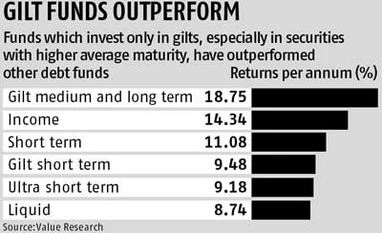
The move is likely to be a positive for giltfFunds, many of whose returns over the past year have been in the late teens or higher, according to data from MF tracker Value Research. Gilt funds (medium and long-term) have given returns of 18.75 per cent over the past year (with the top gain at 23.98 per cent). Short-term gilt funds have given 9.48 per cent.
However, experts have advised a careful approach for investors who wish to take exposure to gilts. Don’t do a reactive sort of strategy,” said Kartik Jhaveri, director, Transcend Consulting (India). He says there shouldn’t be a knee-jerk allocation away from other funds and into gilts for better returns, as other avenues such as equity funds also tend to do well during a period of falling interest rates.
He said dynamic bond funds were a better way for investors to take exposure to gilts. “Its easier...safer and better,” he added.
Suresh Sadagopan, founder of Ladder7 Financial Advisories, said investors who wish to take exposure in gilt funds should do so with a longer time horizon and the returns were likely to be more limited than hitherto.
“I would expect annualised returns of 10-10.5 per cent for investors coming in with a horizon of over two years,” he said.
His advice is similar, to not take direct exposure but invest through dynamic bond funds which have an allocation of 50-60 per cent to gilts. The idea is to give the mandate to move in and out of gilts to a fund manager, rather than an own decision, he said.
Gilt funds are MF schemes which invest only in government bonds. The value of these bonds go up when interest rates go down. Dynamic bond funds invest in various securities, depending on the fund manager’s view of where the best returns are likely.
“Debt investors should continue to stay invested in medium-long debt funds (income/dynamic bond funds). There also still remains enough opportunity for investors wanting to take exposure at this stage with a two-three year view,” said Vidya Bala, head of MF research at FundsIndia.com, in an emailed statement after the RBI announcement.
“The next 18-24 months could potentially offer dual opportunity in the debt space – capital appreciation from easing yields and credit opportunity from improved corporate fortunes. Investors need to have an at least two-year view for both these to pan out,” she added.

 "Gilt funds in focus after RBI rate cut")


