Public Sector Banks are passing through one of their toughest phases over the past few years. Not only are the banks being squeezed for capital, their assets are showing no signs of improvement.
With the government themselves pressed for funds after touching nearly 99% of its fiscal deficit in the first eight months, the Finance Minister is likely to hit the brakes hard on spending for the remaining months, thus further aggravating hopes of revival for the banks. It’s probably the cost control that has led Prime Minister Narendra Modi to ask India’s topmost bankers to travel by bus for a brainstorming session called ‘
Gyan Sangam’ in Pune.
While such tokenism is unlikely to improve the health of banks, it helps in inculcating the message of cost control. Public sector banks will need a lot of such cost control in order to come out of the mess they are in. The recently published Financial Stability Report of the Reserve Bank of India points out the slowing pace of growth of credit and deposit in the banking system.
From the government’s point of view, banks are flushed with funds are deploying excess funds in safer avenues like SLR bonds rather than increasing credit off-take. This has a direct impact on the pace of growth of the economy. From the banker’s point of view, the high level of non-performing assets (NPAs) is acting as a deterrent to lend money in the market. Bankers need assurance from the government that their funds will be protected.
Broking firm Motilal Oswal, in a report on the banking sector, expects the retreat to produce a reform-oriented blueprint for the sector. The resolve of the government, the report says, can been seen from the participants which include the Prime Minister, Finance Minister, finance secretary, RBI governor, all CMDs of public sector banks and financial institutions and industry experts. Hint that the government is ready to take bold steps can be seen from the recent decision by the government to split the Chairman and Managing Director position of the banks, says another report by Motilal Oswal.
Analysts are betting on steps to be announced for consolidation of banks at the discussions in Pune. Both the former Finance Minister P Chidambaram and the present one, Arun Jaitley has talked of creation of large banks in the country. An expanding economy needs larger financial institutions to fuel its needs. The high cost of domestic fund and long tenure of infrastructure projects has been an impediment for funding large projects. RBI has introduced the 5:25 scheme to take care of the need of infrastructure funding, but this is still not enough. Private sector banks and others with longer source of funds like insurers have not been actively participating in infrastructure financing. Government will have to provide a safety net and incentivise the entire banking system to take part in the growth process.
Financial inclusion is a pet theme of Modi government. The Jan Dhan scheme and has already added 10 crore names to the banking system. Bankers have been complaining on the redundancy of such schemes. Benefits likely to accrue through direct benefit transfer schemes, both to the banking system and the economy needs to be demonstrated to gain confidence of bankers and take the scheme forward.
Six broad topics will be discussed in the retreat which include achieving universal financial inclusion; leveraging technology to improve cost efficiency; fostering profitable priority sector lending; effective risk profiling and recovery mechanism; building a robust people motivation strategy for public sector banks; and consolidation and restructuring of PSBs for better efficiency, governance and capital efficiency. But the one that bankers would like a clarity from the government the most is on risk profiling and recovery mechanism. Even the Financial Stability Report has spoken of how willful defaulters are getting political patronage.
A meaningful outcome from the retreat can come only if there is a two way communication. Government needs to provide confidence to the banking sector that their money will be protected. It is the lack of confidence and the recourse of collecting their money in case of defaults is what is preventing banks from lending. If the government gains the confidence of the bankers they would be willing to walk down to the next retreat, let alone taking a bus.
Motilal Oswal points out that time bound and definite reform action will go a long way in reforming PSU Banking system. The blueprint of these reforms will be a key catalyst for re-rating of the PSU banks.

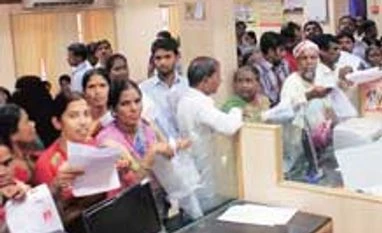 "Why PSU Banks can be re-rated by Modi's 'Gyan Sangam'")


 Connect with us on WhatsApp