NDLS revamp on the cards, to give Lutyens' Delhi a major facelift

IR is likely to invite requests for quotation (RFQs) this month for the Rs 7,500-crore project
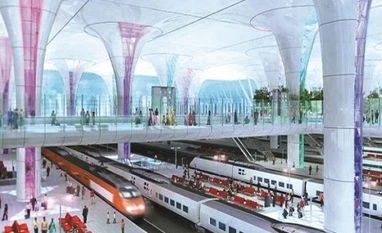
Indian railways
The NDLS overhaul will comprise station redevelopment (3,10,000 sq mt), a new elevated concourse, renovation of 16 platforms, refurbishment of existing station buildings, development of associated infrastructure, elevated access road network and a mu
Shine Jacob New Delhi
4 min read Last Updated : Aug 11 2020 | 6:10 AM IST
Lutyens’ Delhi is on track for a major facelift, with Indian Railways (IR) set to open up New Delhi Railway Station or NDLS — including parts of Connaught Place (CP) and Karnail Singh Stadium — to the private sector for commercial redevelopment.

IR is likely to invite requests for quotation (RFQs) this month for the Rs 7,500-crore project, which will result in comme­rcialisation of a 2,30,000-square metre (sq mt) area, a flyover to decongest traffic at CP, redevelopment of the stadium, and reconstruction of three railway colonies near the station. 

Belgium-based engineering and consulting services major Tractebel is working on a detailed project report (DPR).

The Railway Land Development Authority (RLDA) — a subsidiary of IR — said the first phase of the project would involve development of 110 acres.

“This is going to be a prestigious investment in the heart of the capital. We expect major private players to be in the race. Mandatory cost for the project will be around Rs 5,000 crore. This includes the cost for the station building, concourse, and road network (around Rs 900 crore) that will decongest traffic in CP. In addition, the developer will invest Rs 2,500 crore for the commercial part,” said Ved Prakash Dudeja, vice-chairman, of the RLDA.

By December, the RLDA is planning to invite bids for execution from selected bidders, with the project expected to be completed within 4 years of signing of the concession agreement. 

The NDLS overhaul will comprise station redevelopment (3,10,000 sq mt), a new elevated concourse, renovation of 16 platforms, refurbishment of existing station buildings, development of associated infrastructure, elevated access road network and a multi-level car parking.

Other associated developments to be handed over to Northern Railways will include 40,000 sq mt in railway quarters, 42,000 sq mt in railway offices, and 7,800 sq mt in social infrastructure.

The project is with the Public Private Partnership Appraisal Committee for approval, as well as the finance ministry.

To make it financially viable, the project will include a significant commercial component — entailing a mix of retail, office, and hospitality developments on approximately 30 acres.

The retail space will be of 72,500 sq mt, hotel 35,000 sq mt, and office space 1,03,000 sq mt. It will be on a Design-Build-Finance-Operate-Transfer (DBFOT) basis, for a concession period of 60 years.

This is not the first redevelopment project floated for NDLS. In 2006, Terry Farrell and Partners, a Hong Kong-based architectural firm, had submitted a master plan, including a project of 16 commercial towers from Paharganj to the CP end of the station.

However, the project ran into roadblocks — the proposed shutdown of the station for several months, inclusion of a yard, and the planned 4,60,000-sq mt of commercial space extending up to CP — all of which faced objections from the Delhi Development Authority (DDA). 

Tractebel’s DPR is based on the Terry Farrell model. According to senior officials in the railways, DDA wanted to limit the quantity of land for commercial development in 2006 as CP was involved. In the new model, therefore, only half the area is kept for commercial redevelopment.

“A group of secretaries is looking into the plan. We have got approvals in place from various departments,” added Dudeja. As part of the plan, four colonies around the stations, with 700 houses, will be rebuilt or relocated by the developer.

The selected concessionaire will be able to earn revenue from several components of the project — passenger handling fees via ticket sales; revenues from passenger facilities like retail areas, lounges, parking and advertisement spaces; and income from development and lease of commercial components.

One subscription. Two world-class reads.

Already subscribed? Log in

Subscribe to read the full story →
*Subscribe to Business Standard digital and get complimentary access to The New York Times

Smart Quarterly

₹900

3 Months

₹300/Month

SAVE 25%

Smart Essential

₹2,700

1 Year

₹225/Month

SAVE 46%
*Complimentary New York Times access for the 2nd year will be given after 12 months

Super Saver

₹3,900

2 Years

₹162/Month

Subscribe

Renews automatically, cancel anytime

Here’s what’s included in our digital subscription plans

Exclusive premium stories online

  • Over 30 premium stories daily, handpicked by our editors

Complimentary Access to The New York Times

  • News, Games, Cooking, Audio, Wirecutter & The Athletic

Business Standard Epaper

  • Digital replica of our daily newspaper — with options to read, save, and share

Curated Newsletters

  • Insights on markets, finance, politics, tech, and more delivered to your inbox

Market Analysis & Investment Insights

  • In-depth market analysis & insights with access to The Smart Investor

Archives

  • Repository of articles and publications dating back to 1997

Ad-free Reading

  • Uninterrupted reading experience with no advertisements

Seamless Access Across All Devices

  • Access Business Standard across devices — mobile, tablet, or PC, via web or app

Topics :Indian RailwaysNew DelhiLutyensCommercialisationprivatisationRailway projects

Next Story


