China and Muslim countries silent, Pakistan alone protests Kashmir move

Pakistani analysts demandg to know whether Imran Khan and Donald Trump discussed New Delhi's plans for J&K during their meeting in Washington on July 22.
Pakistan, Article 370, Kashmir
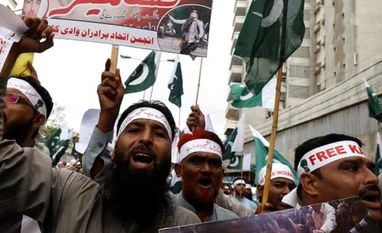
People hold signs and chant slogans as they attend a rally in solidarity with the people of Kashmir, in Karachi, Pakistan August 5, 2019. Photo: Reuters
Ajai Shukla New Delhi
3 min read Last Updated : Aug 05 2019 | 11:27 PM IST
The government’s abrogation of the provisions of Article 370 and the bifurcation of Jammu & Kashmir (J&K) into two union territories – Ladakh and J&K – has evoked little response from governments across the world. 

Pakistan has been the only country to condemn New Delhi’s move. Declaring that “Indian Occupied Jammu and Kashmir is an internationally recognized disputed territory”, the Ministry of Foreign Affairs (MOFA) in Islamabad stated: “As the party to this international dispute, Pakistan will exercise all possible options to counter the illegal steps.”

While Pakistan has long sought to internationalise the Kashmir dispute, Islamabad will be introspecting about whether its apparently successful ploy – in which Prime Minister Imran Khan got President Donald Trump to offer his services in mediating the Kashmir dispute – actually caused New Delhi to move quicker in abrogating Kashmir’s special status.


Pakistani analysts are demanding to know whether Khan and Trump discussed New Delhi’s plans for J&K during their meeting in Washington on July 22, and whether the Pakistan Army was aware of the impending announcement.

“Question is what was DGISI (director general of Pakistan’s Inter-Services Intelligence) doing that he couldn’t gather the intel[ligence] regarding what India had planned in Kashmir? Why did it come as a surprise?” asked Ayesha Siddiqa, the acclaimed author of Pakistan Inc., a book on the Pakistan Army’s business dealings.

Islamabad’s criticism of New Delhi’s bifurcation of J&K is weakened by its own restructuring in 1970 of Pakistan Occupied Kashmir (POK), from which it carved out a federally administered chunk of territory that it designated the “Northern Areas”. New Delhi is now mirroring that Pakistani move, by carving out Ladakh from J&K and designating it a union territory that will be directly administered from New Delhi.

In 2009, President Asif Zardari renamed the Northern Areas as Gilgit-Baltistan and granted the territory a degree of autonomy. However, local activists protest vocally that power continues to rest with the centrally-appointed governor, not the elected assembly.


There was silence too from the Organistation of Islamic Countries (OIC), which tends to be supportive of Pakistan. On August 4, the OIC had stated it was “deeply concerned about the deteriorating situation in the Indian occupied Jammu & Kashmir, including reports of deployment of additional paramilitary forces and use of banned cluster munition by Indian forces to target civilians.” However, the OIC has not reacted to the actual scrapping of Article 370. 

Beijing has remained silent, even though New Delhi has changed the status of Ladakh. China claims large parts of Ladakh, such as the Aksai Chin plateau.

In 1963, Pakistan ceded to China a 6,000 square kilometre chunk of J&K, called the Shaksgam Valley. In countering New Delhi’s protests at the occupation of its claimed territory, China states that its control of Shaksgam is contingent on the final resolution of the J&K dispute. However, Shaksgam will now fall within the union territory of Ladakh, not in J&K.

In contrast to the silence from the international powers, the Indian notification on J&K has been reported widely in the world media, including amongst the lead stories in BBC, CNN and Al Jazeera. 

One subscription. Two world-class reads.

Already subscribed? Log in

Subscribe to read the full story →
*Subscribe to Business Standard digital and get complimentary access to The New York Times

Smart Quarterly

₹900

3 Months

₹300/Month

SAVE 25%

Smart Essential

₹2,700

1 Year

₹225/Month

SAVE 46%
*Complimentary New York Times access for the 2nd year will be given after 12 months

Super Saver

₹3,900

2 Years

₹162/Month

Subscribe

Renews automatically, cancel anytime

Here’s what’s included in our digital subscription plans

Exclusive premium stories online

  • Over 30 premium stories daily, handpicked by our editors

Complimentary Access to The New York Times

  • News, Games, Cooking, Audio, Wirecutter & The Athletic

Business Standard Epaper

  • Digital replica of our daily newspaper — with options to read, save, and share

Curated Newsletters

  • Insights on markets, finance, politics, tech, and more delivered to your inbox

Market Analysis & Investment Insights

  • In-depth market analysis & insights with access to The Smart Investor

Archives

  • Repository of articles and publications dating back to 1997

Ad-free Reading

  • Uninterrupted reading experience with no advertisements

Seamless Access Across All Devices

  • Access Business Standard across devices — mobile, tablet, or PC, via web or app

Topics :Article 35AArticle 370ChinaJammu and KashmirPaksitanImran Khan

Next Story



