China bans Winnie the Pooh, the letter 'N' after Xi's power grab

China's state-run news outlets have played down the move, as if in hopes that most Chinese simply will not notice, or care
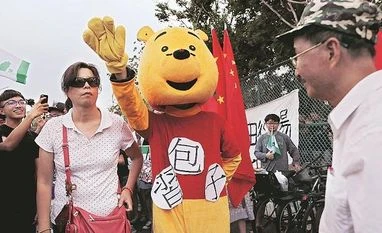
Xi is sometimes likened to the cartoon bear Winnie the Pooh
Javier C Hernández | NYT Beijing
Last Updated : Mar 01 2018 | 8:51 PM IST
Liu Jin, a 27-year-old teacher in central China, is the kind of young nationalist that President Xi Jinping can typically count on. Liu shares propaganda photos of the president in battle fatigues online and reverently calls him “Uncle Xi.”

But Liu was dismayed this week when he heard that the ruling Communist Party was changing the Chinese Constitution, allowing Xi to stay in power indefinitely.

“I disagree,” Liu wrote on Weibo, a microblogging site, listing examples of power-hungry emperors and autocrats. Censors immediately deleted the post.

During his more than five years in power, Xi has cultivated an image as a man of the people — a centered, sympathetic leader who lines up with workers to buy pork buns while also guiding the world’s most populous nation to growth and global influence.

But the move to abolish term limits, announced on Sunday, has resurrected deeper fears in Chinese society, where memories remain of the personality cult of China’s founding father, Mao Zedong, and the fevered emotions and chaos that it conjured.

Anxious to suppress criticism, and maintain an appearance of mass support, the Communist Party’s censors have scoured the internet and social media for content deemed subversive. The sanitising has included many images of Winnie the Pooh — Xi is sometimes likened to the cartoon bear — and search terms like “my emperor,” “lifelong” and “shameless.”

For a short time, even the English letter “N” was censored, according to Victor Mair, a University of Pennsylvania professor, apparently to pre-empt social scientists from expressing dissent mathematically: N > 2, with “N” being the number of Xi’s terms in office.

In their coverage, China’s state-run news outlets have played down the move, as if in hopes that most Chinese simply will not notice, or care. When reports mention the change, they argue that term limits should be eliminated to ensure leadership continuity at a time when China has ambitions to challenge American dominance and reclaim its rightful place on the global stage. “China cannot stop and take a break,” the nationalistic Global Times warned. “The country must seize the day, seize the hour.”

Despite the blanket of censorship, and the fear that many expressed in stating their actual opinions in public, some cracks have appeared in the facade of public unity behind China’s strongman. Retirees who endured the trauma of Mao’s Cultural Revolution are warning of a return to dictatorship. University students are posting quotes from George Washington’s farewell address online. Business executives, concerned about the Communist Party’s growing grip on private enterprises, are hastening plans to relocate overseas.

Li Datong, a former journalist and critic of the government, has circulated an open letter calling on the Communist Party to block  Xi’s plan or risk “once again planting seeds of chaos in China and causing untold damage.” He said that Xi’s power grab would overturn the very stable and predictable system for peaceful transitions of power set up decades ago after the chaos of Mao and succession struggles under Deng Xiaoping.

“It’s going to break the chains placed on the system,” Li said in an interview. “It’s going to be very dangerous.”

While some have likened Xi to Mao, others reached further into Chinese history, comparing Xi to Yuan Shikai, an early 20th-century warlord who briefly restored China’s monarchy with himself as emperor.

For all the discontent, analysts said it was unlikely anything would block Xi’s attempts to extend his rule.

For one, much of the frustration over the term-limits plan is limited to the urban elite. Xi remains immensely popular among farmers and blue-collar workers, as well as a new generation of young nationalists, who admire what they view as his steely drive and see him as the architect of China’s ascent in the 21st century.

“It’s not a bad thing to remove term limits, so long as the leader has strong abilities,” said one such supporter, Mou Yuxiu, 19, a college freshman in the southwestern province of Sichuan. “President Xi is such a person.”

For another, Xi already has an iron grip on Chinese society. A sweeping anticorruption campaign has ensnared tens of thousands of officials and imposed discipline on the Communist Party and other powerful institutions like the People’s Liberation Army, China’s military. There have also been conspicuously public arrests of lawyers and dissidents, including Gui Minhai, a Hong Kong-based publisher who has been in custody for more than two years, apparently for publishing books critical of Xi and China.

While the plan to abolish term limits may be one of the most important political decisions in decades, many citizens are simply unaware of it. The decision has been buried inside newspapers and mentioned only in passing on television news shows.

“I didn’t pay much attention to the change,” said Peng Man, a worker from the countryside now living in Beijing. “It’s a good thing if they are good officials. It’s bad thing, if they are not good officials.”

But for others, Xi’s maneuvering has rekindled memories of the Cultural Revolution, the decade-long upheaval instigated by Mao that fractured Chinese society and left more than one million dead.
©2018 The New York Times News Service

One subscription. Two world-class reads.

Already subscribed? Log in

Subscribe to read the full story →
*Subscribe to Business Standard digital and get complimentary access to The New York Times

Smart Quarterly

₹900

3 Months

₹300/Month

SAVE 25%

Smart Essential

₹2,700

1 Year

₹225/Month

SAVE 46%
*Complimentary New York Times access for the 2nd year will be given after 12 months

Super Saver

₹3,900

2 Years

₹162/Month

Subscribe

Renews automatically, cancel anytime

Here’s what’s included in our digital subscription plans

Exclusive premium stories online

  • Over 30 premium stories daily, handpicked by our editors

Complimentary Access to The New York Times

  • News, Games, Cooking, Audio, Wirecutter & The Athletic

Business Standard Epaper

  • Digital replica of our daily newspaper — with options to read, save, and share

Curated Newsletters

  • Insights on markets, finance, politics, tech, and more delivered to your inbox

Market Analysis & Investment Insights

  • In-depth market analysis & insights with access to The Smart Investor

Archives

  • Repository of articles and publications dating back to 1997

Ad-free Reading

  • Uninterrupted reading experience with no advertisements

Seamless Access Across All Devices

  • Access Business Standard across devices — mobile, tablet, or PC, via web or app

Next Story


