
China's population grows by less than half-a-million as birth rate falls
China's population grew to 1.4126 billion by the end of last year, increasing by less than half-a-million as the birth rate fell for the fifth consecutive year
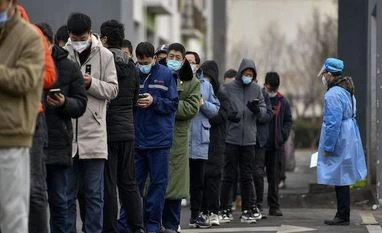 "China's population grows by less than half-a-million as birth rate falls")
WebinarsNew
Deep DiveNew
Explore Business Standard
China's population grew to 1.4126 billion by the end of last year, increasing by less than half-a-million as the birth rate fell for the fifth consecutive year
China's population grew to 1.4126 billion by the end of last year, increasing by less than half-a-million as the birth rate fell for the fifth consecutive year, stoking fears of a looming demographic crisis and a consequent economic slowdown in the world's most populous nation.
At the end of 2021, China's population on the mainland grew to 1.4126 billion from 1.4120 billion in 2020, the National Bureau of Statistics (NBS) said.
China's population increased by 480,000 in a year-on-year comparison from 2020, as per the NBS data.
The number of new births in 2021 stood at 10.62 million, down from 12 million in 2020, Hong Kong-based South China Morning Post reported.
Earlier this month, Henan province, the country's third-most-populous administrative region, reported that its number of newborn children fell to 920,000 in 2020 - a 23.3 per cent decline from 2019 - as the birth rate dropped to 9.24 births per 1,000 people.
Experts have warned that a demographic turning point may be around the corner in China, threatening its booming economic growth, the Post report said.
In such a situation, the ratio of people in the workforce and dependent persons (retired with pension and other benefits) may be adversely affected, straining the economy.
Chinese provinces have started announcing a slew of supportive measures to motivate couples to have three children to prevent a steep decline in birth rates.
Beijing, Sichuan and Jiangxi provinces have rolled out supportive measures such as increased parental leave, maternity leave, marriage leave and paternity leave, state-run Xinhua news agency reported earlier.
China permitted all couples to have two children in 2016, scrapping the draconian decades-old one-child policy which policymakers blame for the current demographic crisis.
Last year China passed a revised Population and Family Planning Law allowing Chinese couples to have three children in an apparent attempt to address the reluctance of couples to have more kids due to mounting costs.
The decision to permit the third child came after the once-in-a-decade census in 2020 showed that China's population grew at its slowest pace to 1.412 billion.
The census figures revealed that the demographic crisis China faced was expected to deepen as the population above 60 years grew to 264 million up by 18.7 per cent.
(Only the headline and picture of this report may have been reworked by the Business Standard staff; the rest of the content is auto-generated from a syndicated feed.)
First Published: Jan 17 2022 | 11:26 AM IST


 Connect with us on WhatsApp