China posts worst factory activity on record as coronavirus weighs

The collapse in economic activity seen in the data was largely due to virus control measures that have made it hard for workers to travel back after Lunar New Year
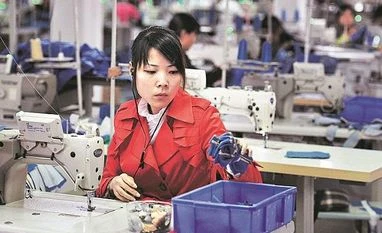
The superbacteria can clean up more efficiently the vast quantities of waste water the textile industry produces in China.
The result will shock markets on Monday, according to Iris Pang at ING Bank NV in Hong Kong, who said the yuan could weaken through 7 to the dollar
Bloomberg
5 min read Last Updated : Mar 01 2020 | 1:23 AM IST
Activity in China’s manufacturing sector contracted sharply in February, with the official gauge hitting the lowest level on record, highlighting the devastating impact of the coronavirus on the economy and raising the risk of a worsening global stock rout.

The manufacturing purchasing managers’ index plunged to 35.7 in February from 50 the previous month, according to data released by the National Bureau of Statistics on Saturday, much lower than the median estimate of economists. The non-manufacturing gauge also fell to its lowest ever, 29.6. Both were well below 50, which denotes contraction

The coronavirus outbreak that started in China is spreading to multiple continents, with the threat of a pandemic tipping US stocks Friday into the worst rout in any week since October 2008. With China, the world’s largest exporter already operating far below capacity as millions of workers and consumers remain quarantined, the data underline the scale of the task to return output to normal at a time when global growth is under threat.

“The sharp drop in China’s manufacturing PMI in February reinforces our view that the normalization in economic activity will be delayed,” as can be seen in high-frequency data, said Xing Zhaopeng, an economist at Australia & New Zealand Banking Group. “There’s scant chance for a V-shaped rebound -- the authorities are using targeted aids more than stimulus to stabilize the economy and that will lead to a gradual bounce.”

The result will shock markets on Monday, according to Iris Pang at ING Bank NV in Hong Kong, who said the yuan could weaken through 7 to the dollar. An index of the biggest 300 Chinese firms listed on the Shanghai and Shenzhen exchanges lost more than 5 per cent in the trading week ended Friday, the most since April last year.

The collapse in economic activity seen in the data was largely due to virus control measures that have made it hard for workers to travel back after Lunar New Year, and left factory owners with limited raw materials to restart production. The key for any recovery this quarter will be how soon factories, companies and people can return to normal, but the government must balance that with the need to stop further infections.

Progress on that front has been made in recent weeks, with Bloomberg Economics estimating Chinese factories were operating at 60% to 70% of capacity this week. The statistics bureau said Saturday that as of Feb. 25, the work resumption rate at mid- and large-enterprises in the PMI survey was 78.9 per cent, and will rise to 90.8 per cent by the end of next month. At medium- and large-scale manufacturing companies, it was 85.6 per cent and will rise to 94.7 per cent by end-March, the NBS said.

However, even if companies have restarted that doesn’t mean that they are back at full capacity, or that the logistics systems in China are working normally. The services sector has taken a hard blow as most businesses rely on human interaction, which is constrained by tight control of people’s mobility within and across cities. The indexes for construction and services both plumbed record lows in data from 2012.

“Most people were comparing the impact of the coronavirus with that of SARS, but I think it is on par with that of the financial crisis in 2008,” said Larry Hu, head of China economic research at Macquarie Securities Ltd. “The shock brought by the coronavirus is huge and the situation looks really bad in the short-term,” although there will be a rebound in March and a significant recovery in the second quarter, he said.

The virus outbreak has prompted economists to scale back their estimates for China’s expansion this quarter, with the median forecast at 4.3 per cent. Analysts are split on whether the economy will suffer a short-term slide that’s swiftly reversed as the virus is brought under control, or a longer-lasting slump.

Zhou Hao, an economist at Commerzbank AG in Singapore, expects a rebound will start from March, but he said that what the market is concerned about is how significant the recovery will be, and 45 in the manufacturing gauge would be a key level to watch.

“It could be around that level but am uncertain that it will be higher. China now seems to stabilize, as it is widely expected that the manufacturing restart rate will be 80 per cent by the end of March, but in other places, the outbreak is spreading, posing new risks,” he said.

In the last week there has been a jump in infections in Japan and South Korea, two countries whose economies and supply chains are intricately linked with China. If the outbreaks there lead to substantial shutdowns for businesses, the economic effects of the coronavirus will last even longer, even if China gets back to normal.

China’s manufacturing activity may be worse than the official data reflect, Lu Ting, chief China economist at Nomura Holdings Inc. in Hong Kong, wrote in a note to clients. The distortion is caused because lengthier delivery times due to the coronavirus are actually pushing up the headline number, Lu said.

Longer delivery times usually indicate higher demand but in this case it was “due to travel bans instead of good business,” according to Lu.

One subscription. Two world-class reads.

Already subscribed? Log in

Subscribe to read the full story →
*Subscribe to Business Standard digital and get complimentary access to The New York Times

Smart Quarterly

₹900

3 Months

₹300/Month

SAVE 25%

Smart Essential

₹2,700

1 Year

₹225/Month

SAVE 46%
*Complimentary New York Times access for the 2nd year will be given after 12 months

Super Saver

₹3,900

2 Years

₹162/Month

Subscribe

Renews automatically, cancel anytime

Here’s what’s included in our digital subscription plans

Exclusive premium stories online

  • Over 30 premium stories daily, handpicked by our editors

Complimentary Access to The New York Times

  • News, Games, Cooking, Audio, Wirecutter & The Athletic

Business Standard Epaper

  • Digital replica of our daily newspaper — with options to read, save, and share

Curated Newsletters

  • Insights on markets, finance, politics, tech, and more delivered to your inbox

Market Analysis & Investment Insights

  • In-depth market analysis & insights with access to The Smart Investor

Archives

  • Repository of articles and publications dating back to 1997

Ad-free Reading

  • Uninterrupted reading experience with no advertisements

Seamless Access Across All Devices

  • Access Business Standard across devices — mobile, tablet, or PC, via web or app

Topics :China manufacturing PMI

Next Story



