Covid-19: China lockdowns costing $46 billion a month, say experts

A worst-case scenario would be a lockdown of all cities for one month, which would cut national GDP by 53 per cent over that period.
coronavirus
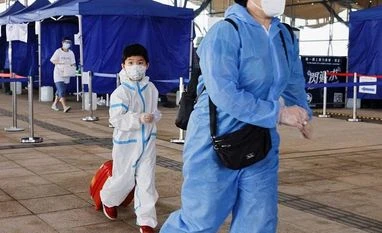
People wearing personal protective equipment walk at the Hong Kong-Zhuhai-Macao Bridge Hong Kong Port, amid the coronavirus pandemic, in Hong Kong (Photo:Reuters)
Bloomberg
2 min read Last Updated : Mar 30 2022 | 12:24 AM IST
China’s Covid lockdowns are likely costing the country at least $46 billion a month, or 3.1 per cent of GDP, in lost economic output, and the impact could double if more cities tighten restrictions.

That’s a minimum estimate from Zheng Michael Song, an economist at the Chinese University of Hong Kong based on the assumption that cities generating about 20 per cent of China’s gross domestic product are currently imposing targeted lockdowns. That cost would double if those areas had to follow Shanghai and impose stricter policies requiring most residents to remain at home. The 3.1 per cent estimate — equivalent to 295 billion yuan ($46.3 billion) — is “conservative,” he added, as it doesn’t include the effect on incomes through inflation.

Song and his team use data on the location of nearly 2 million trucks which crisscross China, and whose movements are highly correlated with local economic activity.  A strict lockdown in Shanghai alone could reduce China’s real GDP by 4 per cent, Song and his co-authors estimate. If China’s four largest cities all underwent a strict lockdown together, national inflation-adjusted GDP would fall 12 per cent for the duration of the shutdowns.

 A worst case scenario would be a lockdown of all cities for one month, which would cut national GDP by 53 per cent over that period.

Bankers who remain in HK get pay bonanza
 
Hong Kong’s stringent Covid restrictions turned the city into a dead end for the legions of finance workers decamping for other destinations. Those who choose to stay are being heavily rewarded.  Typically, finance workers in Hong Kong would get roughly a 15 per cent “walking across the street money” pay hike to make up for the risk of moving to a new employer, said Christine Houston, managing director of executive search firm ESGI said. Now, it’s “certainly no less than 20 per cent to
30 per cent.”    

One subscription. Two world-class reads.

Already subscribed? Log in

Subscribe to read the full story →
*Subscribe to Business Standard digital and get complimentary access to The New York Times

Smart Quarterly

₹900

3 Months

₹300/Month

SAVE 25%

Smart Essential

₹2,700

1 Year

₹225/Month

SAVE 46%
*Complimentary New York Times access for the 2nd year will be given after 12 months

Super Saver

₹3,900

2 Years

₹162/Month

Subscribe

Renews automatically, cancel anytime

Here’s what’s included in our digital subscription plans

Exclusive premium stories online

  • Over 30 premium stories daily, handpicked by our editors

Complimentary Access to The New York Times

  • News, Games, Cooking, Audio, Wirecutter & The Athletic

Business Standard Epaper

  • Digital replica of our daily newspaper — with options to read, save, and share

Curated Newsletters

  • Insights on markets, finance, politics, tech, and more delivered to your inbox

Market Analysis & Investment Insights

  • In-depth market analysis & insights with access to The Smart Investor

Archives

  • Repository of articles and publications dating back to 1997

Ad-free Reading

  • Uninterrupted reading experience with no advertisements

Seamless Access Across All Devices

  • Access Business Standard across devices — mobile, tablet, or PC, via web or app

Topics :CoronavirusLockdownOmicronDelta variant of coronavirusChina economyChina GDPChina

Next Story



