Iran's Rouhani backs people's right to protest

Authorities restricted access to Iran's most popular social-media platform in response to one of the biggest shows of dissent against the country's leadership in years
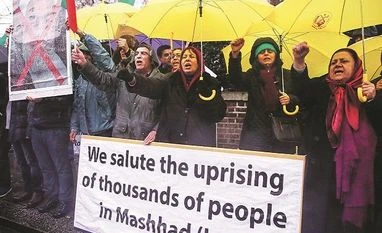
Iran protest
Opponents of President Hassan Rouhani hold a protest outside the Iranian embassy in west London on Sunday. Photo: Reuters
Golnar Motevalli | Bloomberg
Last Updated : Jan 02 2018 | 2:14 AM IST
Iranian President Hassan Rouhani said his country’s people have the right to protest and criticize but that such actions must be for the good — and rejected US President Donald Trump’s backing of demonstrators.

Rouhani first comments since protests against the condition of Iran’s economy started on December  28, were reported by the semi-official ISNA news agency following an Iranian cabinet meeting in Tehran. Earlier on Sunday, Iran restricted social media access, drawing a fresh rebuke from Trump. The government won’t tolerate damage to public property and protesters who cause social disruption, Rouhani said, adding that demonstrations shouldn’t make the public fear for their safety.

Rouhani said Trump — who tweeted that the US is watching “very closely” for human rights violations during the protests — has no right to show sympathy for Iranians after branding them terrorists a few months ago.

The government and the people must “work hand-in-hand” and “as partners,” and concerns about household incomes, corruption and transparency in state institutions must be addressed, he added.

Earlier, Iranian police arrested about 200 people in the capital following weekend protests. Authorities restricted access to Iran’s most popular social-media platform in response to one of the biggest shows of dissent against the country’s leadership in years.

Trump posted a separate Twitter message on Sunday after Rouhani’s remarks that Iran’s response was “Not good!”

“Iran, the Number One State of Sponsored Terror with numerous violations of Human Rights occurring on an hourly basis, has now closed down the Internet so that peaceful demonstrators cannot communicate,” Trump said in his message.

Two people died in clashes with security forces late Saturday in the western city of Dorud, the first casualties since anti-government protests erupted on Thursday. Ten people were killed on Sunday, state television reported, as unsigned statements posted on social media sites called for new demonstrations in the capital Tehran and 50 other cities. Iran’s powerful Revolutionary Guard Corps vowed to take tough action if the unrest continued, and stocks fell Sunday to their lowest level in more than a week. 

The rare public challenge to the government and the country’s Supreme Leader, Ayatollah Ali Khamenei, has erupted at a time of deepened strains between the US and Iran. Trump has imposed additional sanctions on Tehran and threatened to quit Iran’s 2015 nuclear accord with world powers.

In another Twitter post on Sunday, Trump said, “The people are finally getting wise as to how their money and wealth is being stolen and squandered on terrorism.” “Looks like they will not take it any longer,” he said. “The USA is watching very closely for human rights violations!” Scores of Iranians responded via Twitter, criticizing Trump’s statements and ridiculing his stance toward Iran.

The semi-official Iranian Labour News Agency said about 200 people who had been protesting in Tehran on Saturday had been arrested, quoting the city’s deputy police commander for security, Ali Asghar Naserbakht.

The protests, which began in the northeastern city of Mashhad, initially targeted the government’s handling of the economy, winning the backing of hardliners critical of Rouhani and the nuclear deal. But it took less than a day for the focus to expand to include the state system, including the religious establishment and state security forces close to the hardliners.

By Saturday, unverified video footage shared on Iran’s Telegram social media site, Twitter and Instagram from several cities across the country showed demonstrators calling for Khamenei’s ouster.

Demonstrations, which extended to at least 20 locations late last week, continued on Sunday. In Tehran, photos published by the semi-official Fars news showed police deploying water cannons where people gathered on Vali Asr junction, one of the city’s busiest thoroughfares. Telegram’s chief executive, Pavel Durov, wrote on Twitter that Iranian authorities are blocking access “for the majority of Iranians.” The move came after the company refused to shut down a number of “peacefully protesting channels,” Durov said.

Largest Since 2009

The government said the restrictions are temporary.

The demonstrations are among the largest seen since in the Islamic Republic since millions of Iranians took to the streets to protest the disputed re-election of hardline former President Mahmoud Ahmadinejad in 2009. Government officials say the latest unrest is part of a wider attempt by Rouhani’s opponents to discredit his leadership. Iran’s hardline media have said justified criticism of the government has been hijacked by a wider foreign plot to sow sedition in the country.

The Revolutionary Guard -- whose mandate is to safeguard the Islamic Revolution -- warned late Saturday that it would respond with “a hard punch” if demonstrations didn’t stop. 

‘Improper Behavior’

Protesters “must certainly know that improper behavior will be to their detriment, and the nation will come out and stand against these actions and throw a hard punch in their faces,” the Revolutionary Guard’s commander for security in Tehran, Brigadier General Esmail Kowsari, said, according to a statement carried by the semi-official Iranian Students’ News Agency late Saturday.

The unrest rippled through Iran’s stock exchange. The TEDPIX Index fell 1.7 percent to 95,561.58 in Tehran on Sunday, the lowest level since Dec. 20, according to data on the bourse’s website.

Bloomberg

One subscription. Two world-class reads.

Already subscribed? Log in

Subscribe to read the full story →
*Subscribe to Business Standard digital and get complimentary access to The New York Times

Smart Quarterly

₹900

3 Months

₹300/Month

SAVE 25%

Smart Essential

₹2,700

1 Year

₹225/Month

SAVE 46%
*Complimentary New York Times access for the 2nd year will be given after 12 months

Super Saver

₹3,900

2 Years

₹162/Month

Subscribe

Renews automatically, cancel anytime

Here’s what’s included in our digital subscription plans

Exclusive premium stories online

  • Over 30 premium stories daily, handpicked by our editors

Complimentary Access to The New York Times

  • News, Games, Cooking, Audio, Wirecutter & The Athletic

Business Standard Epaper

  • Digital replica of our daily newspaper — with options to read, save, and share

Curated Newsletters

  • Insights on markets, finance, politics, tech, and more delivered to your inbox

Market Analysis & Investment Insights

  • In-depth market analysis & insights with access to The Smart Investor

Archives

  • Repository of articles and publications dating back to 1997

Ad-free Reading

  • Uninterrupted reading experience with no advertisements

Seamless Access Across All Devices

  • Access Business Standard across devices — mobile, tablet, or PC, via web or app

Next Story



