
Oil slides on release of strategic reserves and China lockdowns
Bank of America maintained its forecast for Brent crude to average $102 a barrel for 2022-23, but it cut its summer spike price to $120
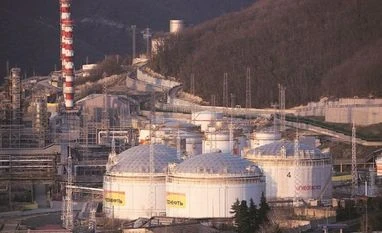 "Oil slides on release of strategic reserves and China lockdowns")
WebinarsNew
Deep DiveNew
Explore Business Standard
Bank of America maintained its forecast for Brent crude to average $102 a barrel for 2022-23, but it cut its summer spike price to $120
By Bozorgmehr Sharafedin
LONDON (Reuters) - Oil prices dropped by more than $2 a barrel on Monday after a second straight weekly decline on plans to release record volumes of crude and oil products from strategic stocks and on continuing coronavirus lockdowns in China.
Brent crude for June delivery was down $2.08, or 2%, at $100.70 a barrel by 0940 GMT. U.S. West Texas Intermediate crude lost $2.19, or 2.2%, to $96.07.
Bank of America maintained its forecast for Brent crude to average $102 a barrel for 2022-23, but it cut its summer spike price to $120. Swiss investment bank UBS also lowered its June Brent forecast by $10 to $115 a barrel.
"The release of strategic government oil reserves should ease some market tightness over the coming months, reducing the need for oil prices to rise to trigger near-term demand destruction," said UBS analyst Giovanni Staunovo.
International Energy Agency (IEA) member nations will release 60 million barrels over the next six months, with the United States matching that as part of its 180 million barrel release announced in March.
The moves are aimed at offsetting a shortfall in Russian crude after Moscow was hit with heavy sanctions over its invasion of Ukraine, which Moscow describes as a "special military operation".
The release of Strategic Petroleum Reserve (SPR) volumes equals 1.3 million barrels per day (bpd) over the next six months and is enough to offset a shortfall of 1 million bpd of Russian oil supply, JP Morgan analysts said.
The European Union's executive is drafting proposals for a possible EU oil embargo on Russia, the foreign ministers of Ireland, Lithuania and the Netherlands said on Monday, though there is still no agreement to ban Russian crude.
The market has also been watching developments in China, where authorities have kept Shanghai, a city of 26 million people, locked down under its "zero tolerance" policy for COVID-19. It was announced that Shanghai will start easing lockdowns in some areas from Monday.
"Fears are rising now that if China's Omicron wave spreads to other cities, its zero-COVID policy will see mass extended lockdowns that negatively impact both industrial output and domestic consumption," said OANDA senior market analyst Jeffrey Halley.
UBS analyst Staunovo said that demand for oil will be affected in China - the world's biggest oil importer - by pandemic-driven mobility restrictions and in Russia by international sanctions.
Fuel demand in India, the world's third-biggest oil importer and consumer, rose to a three-year high in March, with petrol sales hitting a record peak.
U.S. President Joe Biden will hold a virtual meeting with Indian Prime Minister Narendra Modi on Monday, the White House said, at a time when the United States has made it clear it does not want to see an uptick in Russian energy imports by India.
(Reporting by Bozorgmehr Sharafedin in London; Additioanl reporting by Florence Tan and Isabel Kua in Singapore and David Gaffen in New York; Editing by David Goodman)
(Only the headline and picture of this report may have been reworked by the Business Standard staff; the rest of the content is auto-generated from a syndicated feed.)
First Published: Apr 11 2022 | 4:01 PM IST


 Connect with us on WhatsApp