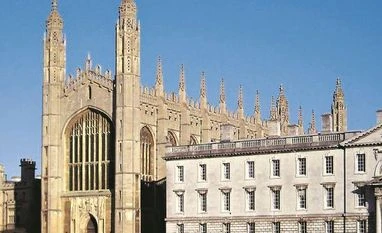
When you step off the train here and walk into the city square outside the railway station, you will not see the spires of King’s College Chapel or the turrets atop the Trinity Great Court. The University of Cambridge is still a cab ride away. But you will see a stone and glass office building with a rooftop patio. This is where Amazon designs its flying drones.
Just down the block, inside a stone building of its own, Microsoft is designing some sort of computer chip for artificial intelligence. And if you keep walking, you will soon reach a third building, marked with a powder-blue Apple logo, where engineers are pushing the boundaries of Siri, the talking digital assistant included with every iPhone.
For years, journalists, city planners and other government officials have called this “Silicon Fen,” envisioning the once sleepy outskirts of Cambridge as Britain’s answer to Silicon Valley. The name — a nod to the coastal plain, or Fenlands, that surrounds Cambridge — never quite stuck. But the concept certainly did, so much so that the world’s tech powers have moved in, snapping up engineers and researchers, particularly in the burgeoning field of artificial intelligence.
Their arrival provides a welcome fillip for the British economy that’s expected to be bruised by its departure from the European Union. Apple, Amazon and Google established research and engineering hubs in Britain by acquiring companies that emerged from local universities, spending millions or even hundreds of millions of dollars.
There are more than 4,500 high-tech firms in Cambridge, employing nearly 75,000 people, many of them commuters from other communities, according to Cambridge Network, a city business group.
Just across the street from Amazon’s Cambridge headquarters, ARM, the computer chip company owned by SoftBank, the Japanese tech giant, recently moved a team of engineers into a row of temporary offices. And a new building is going up just yards away. This is where Samsung, the South Korean tech conglomerate, will soon open another artificial intelligence lab, hiring as many as 150 researchers, engineers and other staff.
“For anybody who hasn’t been here for 20 years, they may say: ‘Is this the same place?’” said Claire Ruskin, the chief executive of Cambridge Network, as she drove through the city on a recent afternoon.
But those buildings outside the train station are reminders that Britain — like Europe as a whole — does not have its own internet powerhouse, a corporate power capable of pushing the world in new technical, cultural and political directions. The closest match was ARM, and that was acquired by SoftBank in 2016.
In London, a 45-minute train ride from Cambridge, you will find DeepMind, perhaps the world’s leading AI lab. DeepMind is at the forefront of a technological revolution that many believe will shift economic and societal norms across the globe, and it was acquired by Google in 2014.
“We welcome the big existing companies,” said Matthew Hancock, the British secretary of state who oversees digital policy. “But we’re incredibly determined to ensure that the next generation of companies are built here.”
On a recent Friday morning, Chris Bishop, who oversees Microsoft Research Cambridge, looked out his fifth-floor office window, with its panoramic view of Cambridge, and pointed to the spires of King’s College Chapel rising over the trees in the distance. “Alan Turing was at King’s,” he said.
©2018 The New York Times News Service